March Madness is done. Monday night, the Michigan Wolverines held off the UConn Huskies for the NCAA basketball title, and college free agency, otherwise known as “The Transfer Portal,” is now open and active.
Let the bidding wars begin as leading players jockey for top dollar—sometimes as high as $3 or $4 million for a single season.
Say what? Yep. You heard right. $3 or $4 million. This ain’t your father’s college athletic environment.
I think Mike Krzyzewski, the former basketball coach at Duke, said it best when it comes to the madcap, multi-million-dollar athletic environment that embraces today’s college athletic programs.
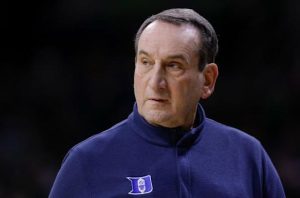
“In today’s athletic environment, it’s all about the two M’s—Money and Minutes,” Hall of Famer Krzyzewski said in an interview just before the NCAA’s Final Four men’s basketball games began last Saturday.
He’s right.
With Name, Image, and Likeness (NIL) money being paid to top athletes and the wide-open transfer portal, which allows athletes to transfer to other colleges as often as they want without any penalty, the world of the college basketball coach has never been so unpredictable or exasperating.
Today, when a basketball coach is on the road recruiting, it is all about how much NIL and revenue-sharing money a player will earn and how many minutes he will play per game.
Forget about such quaint qualities as tradition, campus life, and dear old Alma Mater when it comes to most of today’s college athletes—especially those athletes who are considered superstars at the college level.
Roughly 2,000 college basketball players are expected to hit the portal again in 2026, but unlike last year, college programs are expected to prioritize player retention over bringing in new players this cycle.
Good luck with that.
Even though the NCAA approved a much shorter transfer window that only opened after the championships concluded, it nevertheless prevented the portal from overshadowing March Madness. The window to enter the portal is now only 15 days long (down from 30–45 days in previous years).
In an Executive Order titled “Urgent National Action to Save College Sports,” President Trump has requested that the NCAA reconsider a “one-time transfer” limit and a five-year total eligibility cap. It is, Trump said, an effort to stabilize college sports by imposing national standards that override the current “chaotic” state of varying state laws and court rulings.
It is the most significant federal intervention in the history of collegiate athletics, but legal experts doubt that the restrictions in the order would hold up in court.
In any case, Trump’s order will not affect the current transfer portal. There will still be plenty of expected and unexpected departures, and as always, some big names will enter the portal, much to the dismay of their coaches and fans.
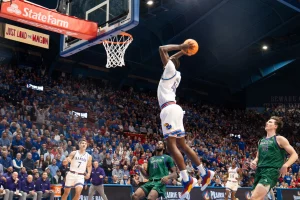
Case in point, 6’10” sophomore Kansas basketball center Flory Bidunga, who was born in the Democratic Republic of the Congo and has spent the past two years playing for the Kansas Jayhawks, which also happens to be my alma mater.
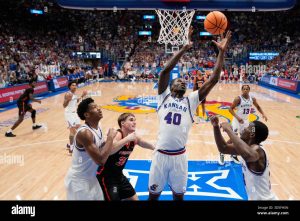
Bidunga is a rare and gifted athlete blessed with amazing leaping ability, agility, and speed. A master rim protector and shot blocker who was just at ease playing above the rim as he was below it, Bidunga averaged 13.3 points, 9.0 rebounds, and 2.6 blocks per game, earning Big 12 Defensive Player of the Year honors.
Not long after the 2026 season ended for Kansas with a second-round one-point loss to St. John’s in the NCAA tournament, Bidunga announced he was going to test the lucrative waters of the National Basketball Association as well as his value in the college basketball transfer portal.
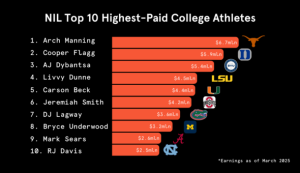
Rumors within the transfer portal indicate Bidunga’s “asking price” for a potential new school (or to stay at Kansas) is approximately $2.5 million to $5 million. While some insiders dispute the $5 million figure as hyperbole, they confirm that a valuation around $2.5 million is realistic for his defensive impact. To put this in perspective, other top stars in 2026, like BYU’s AJ Dybantsa, have reached NIL valuations of $4.2 million.
The world of college athletics has undeniably changed since I was in college in the 1960s. Back then, if you were a scholarship athlete, your tuition, books, and room and board were paid. Any spending money had to be earned via part-time or summer jobs.
Was it a fair system? No, it wasn’t, but it was the only system in place, and if you were fortunate enough to win an athletic scholarship, you were just happy to go along to get along. The “Big” money would come at the next level—the NFL, the NBA, or another professional sports league.
Of course, given the fact that less than 1.2 percent of college basketball players make it to the NBA today, getting the “Big Money” is far from reality for most college players. About 21 percent of draft-eligible NCAA players who are not drafted by the NBA go on to play professionally in the NBA’s G League or one of several international leagues.
There are roughly 19,200 men’s basketball players across all NCAA divisions (I, II, and III). Out of about 4,270 draft-eligible players each year, only around 50–60 are selected in the Draft by the 30 NBA teams for just 239 roster spots.
In the 1960s and 1970s, there were only between 9 and 14 NBA teams, and if you didn’t make one of the 100 NBA roster spots, your career was essentially over. Today, a standout player from a blue-blood basketball school like Kansas who isn’t drafted by the NBA still has a high probability (over 60% for Power 5 starters) of signing a professional contract worth millions in Europe, Asia, or the Middle East.
That possibility didn’t exist for college athletes in the 1960s or 1970s, so there was no big money for them.
Today, the big money is already available to college athletes via NIL and recently instituted revenue sharing. Beginning July 1, 2025, schools were permitted to share up to $20.5 million annually directly with athletes.
I will use my alma mater to explain how revenue sharing works. The University of Kansas is projected to spend $18.9 million on revenue sharing and Alston awards for the 2025–26 fiscal year.
(FYI, an Alston award is a specific type of financial payment that college athletes can receive from their universities as a reward for academic achievement. The awards are named after the 2021 U.S. Supreme Court case, NCAA v. Alston, in which the Court unanimously ruled that the NCAA could not limit “education-related benefits” for student-athletes. This allowed schools to provide “academic incentive” payments and other benefits (like computers, study abroad, or post-graduate internships) that were previously banned under the NCAA’s strict “amateurism” rules.)
Okay, back to revenue sharing. While specific per-player payouts are not always public, estimates for Power 5 men’s basketball players suggest an average revenue-sharing check of roughly $205,000 per year.
Such is the world of college athletics today. Players like Flory Bidunga are not only cleaning up via $205,000 in annual revenue-sharing income, but Bidunga is also currently earning a reputed $1 million a year to play for the Jayhawks.
He is currently projected as the No. 44 (second-round) pick in the 2026 NBA Draft. Because a second-round NBA contract often provides less guaranteed money than elite college NIL deals, Bidunga’s decision to enter the portal suggests he is weighing whether a third year of college is more lucrative than going pro.
The question is whether he will remain at Kansas or transfer to another Power Five program, such as Kentucky, Duke, or Michigan, that will shell out $4 million in NIL money to him.
Bidunga’s entry into the transfer portal has reportedly ignited a bidding war. Some reports suggest his agent is asking for as much as $5 million, though more conservative industry insiders put the realistic “closing” number closer to $2.5 million to $3 million.
The $3 million figure is widely considered the “sweet spot” that would likely keep Bidunga from the NBA draft this year. KU is currently navigating a budget deficit due to these new costs, so the big question is whether university boosters will bridge the gap to match a $3- or $ 4-million offer from another powerhouse program.
Given that Bidunga entered the transfer portal once before (after his freshman year, only to return to KU), I must wonder if entering the portal again this year is a genuine move to leave, or just a high-leverage negotiation tactic to get Kansas to pay up?
College athletes never had to consider such elevated fiscal questions in the 1960s. My biggest decision at the end of the school year was whether to work on the wheat harvest in Kansas and Nebraska or to go with my grandfather’s company to strip blue grass seed in North Dakota and South Dakota. I stood to make $100 a week (tax-free) on the wheat harvest and maybe $95 a week (also tax-free) working with my grandfather. (Farm income back in those days wasn’t taxed, and $100 a week was BIG money for me.)
I guess it’s all relative. Just as players today can’t imagine playing without a 3-point line (that wasn’t instituted in the college game until the 1986-87 season), I still can’t grasp that there are 18-and 19-year-olds earning a million dollars a season to play basketball while they are still in college.
Yet, I can’t fault them for earning those millions of dollars. Their talent earns millions of dollars for the universities they play for, so why shouldn’t they share in the profits via NIL or revenue sharing?
For the purists who believe in the inviolability of the “amateur student athlete” as opposed to the “professional” version we see today, I say the idea of “amateurism” is a term that was a legal and economic construct from the past rather than a biological or educational necessity. The consensus among legal experts and economists is that “amateurism” in colleges and universities was, in the past, a $19 billion industry built on a labor model that could no longer survive modern antitrust scrutiny.
The most powerful justification for that view comes from the U.S. Supreme Court. In the landmark NCAA v. Alston ruling, the Court essentially decided that the NCAA’s “amateurism” rules were not a sacred tradition, but a violation of federal law.
Legal experts argue that other students on campus (musicians, computer programmers, and YouTubers, etc.) have always been allowed to profit from their skills. Denying that right only to athletes was legally indefensible. By the same token, non-athlete students are free to transfer to other colleges or universities whenever they want, so why can’t student athletes?
I know many fans, former coaches, and players bemoan the end of amateurism and the loss of school loyalty. With the transfer portal and NIL, many feel college sports have become a “pro-style” free-agency business in which players follow the highest bidder rather than school pride.
Maybe it’s time for a reality check. For the “non-superstars”—which includes most starters in non-revenue sports and backup players in football—the earnings are much more modest. According to data from the College Sports Commission, most individual NIL deals are for less than $1,000.
A Power 4 non-star basketball player currently earns between $50,000 and $100,000 annually from revenue sharing and NIL deals.
That’s not chicken feed, but it is far from the $1 to $2 million star players earn. Currently, about 50 athletes out of some 500,000 athletes across all college sports earn $1 million or more annually. The highest-paid college basketball player (BYU’s AJ Dybantsa) is reportedly earning $4.2 million.
There is a fear that athletes are now “employees first” and “students second.” Purists argue that the pressure of managing a six-figure NIL brand and a professional-level schedule undermines the original goal of a college education.
Other critics say the new NIL and revenue-sharing rules put Olympic sports at risk. Because revenue sharing is mostly generated by football and men’s basketball, there is a legitimate concern that schools will cut “non-revenue” sports like gymnastics, swimming, or wrestling to balance the books.
However, I don’t see this as the “death” of college sports, but rather an evolution into a professionalized academic model. Education remains the baseline. Athletes must attend class and maintain a GPA to be eligible for Alston Awards and revenue sharing.
As an emeritus professor and former college dean at the University of Illinois, I am happy to see that attending classes and maintaining a minimum GPA are still required for student-athletes.
At the same time, I would argue that managing NIL deals provides a better education in financial literacy, contract law, and personal branding than a traditional classroom ever could. After all, it is the student athlete’s money, and he (or she) should know how to manage it.
Ultimately, the justification for NIL and revenue sharing is that fairness outweighs nostalgia. While the “purity” of the 1960s and 1970s might be gone, you could argue it was only possible because student-athlete labor was artificially undervalued.
And we shouldn’t forget certain realities of those days of “pure amateurism.” Student-athletes were often subsidized by boosters, wealthy alumni, and even universities themselves in violation of NCAA rules. As a result, colleges and universities were often penalized for those violations, with so-called “death penalties,” such as restrictions on scholarships, no post-season bowl and tournament appearances, heavy fines equal to 20 percent of a school’s athletic budget, and multi-year probations.
It’s refreshing to see the hypocrisy eliminated when it comes to college athletics and athletes. At least student athletes are getting paid above board today.
So will I be happy to see Flory Bidunga or other talented players leave the Jayhawk basketball roster for another, higher-paying program that also promises more PT (playing time)?
No, I won’t. But I will understand the financial reasons for it, even if I am sad about the lack of “Jayhawk” loyalty.
Rock Chalk!
–30–
If you enjoyed this post, please consider subscribing to ForeignCorrespondent and tell your friends to subscribe. “It’s free—what a deal!” If you’ve received this from a friend and would like to be added to our distribution list for future blog posts, simply enter your email in the notifications box to sign up:
https://ronaldyatesbooks.com/category/foreign-correspondent.
You can also find my commentaries on Substack at https://ronyates.substack.com/ and the American Free News Network at https://afnn.us.
Please feel free to comment: We genuinely love hearing from you!