
I read an essay the other day stating that a new Department of Labor report on men found that the American labor force is missing about 7 million men who would otherwise be working. This means close to one-third of all men of working age are not included in the labor force.
The report said that the labor force participation rate among “prime age men,” age 25 to 54, in the 1950s, approached 100 percent. Today, it is 89 percent, meaning roughly 11 percent are not in the labor force (neither working nor looking for work). Among all men older than 16 years of age, the rate is a devastatingly low 66 percent, so about one-third are gone.
The story went on to explain that as many as one-third of American men lack purpose and meaning in their lives.
That may be true, but that can’t be the only reason men are missing in America today. In fact, the reasons they are missing vary from popular assumptions. According to the Bureau of Labor Statistics and data from the Current Population Survey, these men are not classified as “unemployed” because they are not actively seeking work.
When surveyed, the vast majority do not report being unable to find a job; rather, they say they do not want one or cannot hold one due to specific life circumstances.
By far the biggest reason given is illness or disability. Between 40% to 55% of prime-age men out of the labor force report chronic illness or physical/mental disability as the primary barrier. This has been heavily compounded over the last two decades by the opioid epidemic, which devastated working-class communities.
But there are other reasons for America’s missing men.
For example, a significant number of younger men in the “missing” cohort are enrolled in school or specialized training programs, delaying their entry into the full-time workforce.
And, while they are still a minority, a growing number of men are stay-at-home fathers or primary caregivers for aging parents.
There has also been a significant structural shift in work and the workplace that has contributed to the disappearance of working-age men in America. In the 1950s, the economy was heavily anchored by manufacturing and physical labor—sectors where a man could secure a stable, family-supporting wage with a high school diploma. As the American economy shifted toward service, technology, and information, many men who lost blue-collar jobs struggled to transition into fields requiring different skill sets, leading to a long-term retreat from the job market.
While all of those seem like logical reasons for the disappearance of men, sociologists and other experts say there are many other questions about men in America that need answering.
For example, why are 70%+ of young adults unqualified for military service? A new Pentagon report states that roughly 77% of young Americans (ages 17 to 24) are ineligible for military service without a waiver. It’s a major concern for national security and military leaders. However, the reasons are strictly clinical and legal rather than ideological, the report said.
Pentagon data show that roughly 11% of young Americans are disqualified for weight alone, and it is a major contributing factor for the 44% who fail for multiple overlapping reasons. Physical inactivity and changing dietary habits (fast food and overeating) mean that a third of young adults are too heavy to meet standard enlistment requirements.
Another contributor is a history of substance abuse or failing a drug screening. That accounts for roughly 8% of single-cause disqualifications, says the Pentagon.
Then, there are chronic medical conditions such as asthma or eyesight issues, and documented histories of mental health treatments that account for significant percentages of those who are rejected for military service.

Legal misconduct or felony records disqualify roughly 10% of the demographic, followed by academic disqualification (failing to graduate from high school or scoring too low on the Armed Services Vocational Aptitude Battery), which is a smaller percentage than health and physical fitness failures.
When I joined the Army in the 1960s, a landmark report by the President’s Task Force on Manpower Conservation titled “One-Third of a Nation” revealed that roughly 33% of young men examined for the Selective Service were failing the standard military induction examinations.
The fact that one-third of the nation’s young men were failing to qualify for military service was considered a national disgrace at the time. Military leaders worried that the nation wouldn’t have enough able-bodied men to populate its branches.
What would they say today when more than three-fourths of America’s young men are failing to qualify for military service?
When the draft escalated heavily during the mid-to-late 1960s because of the war in Vietnam, the overall historical rejection rate hovered around 40% of all registrants examined.
During the Cold War and Vietnam War eras, rejections were split almost evenly between medical/physical defects and mental/educational deficits, heavily influenced by mid-century socioeconomic conditions.
Unlike today’s crisis of over-nutrition, mid-century physical rejections were frequently caused by the lingering effects of childhood poverty, malnutrition, and a lack of preventative healthcare. Common medical disqualifiers included poor eyesight, dental decay, orthopedic defects (often from untreated childhood injuries or polio), residual effects of tuberculosis, and general physical underdevelopment.
A substantial portion of rejections, roughly half of the total denials, was due to an inability to pass the Armed Forces Qualification Test (AFQT). In the 1950s and 1960s, this was primarily a reflection of high school dropout rates and severe regional disparities in public education, which left many young men functionally illiterate or lacking basic mathematical skills.
In the 1960s, the Selective Service used a process called “channeling.” By providing widespread deferments for marriage, fatherhood, higher education, and essential civilian occupations (such as engineering or teaching), the system deliberately funneled high-aptitude men away from induction, meaning the pool of men who showed up to be examined at induction centers often had a disproportionately high baseline rejection rate.
Ultimately, while military leaders in the 1960s viewed a 33% rejection rate as a “dark blot” on American public health and education, today’s 77% ineligibility rate represents a far more complex gridlock of systemic obesity, clinical mental health histories, and modern legal standards—making the recruiting landscape for the modern all-volunteer military uniquely challenging compared to the era of the draft.
Beyond changes in work and military service, the broader social landscape has also played a role in the disappearance of so many American men.
For example, sociologists often point to a pattern in which young men stay at home longer, spend more time on video games, and delay marriage or serious relationships.

Why?
When I was growing up in the mid-20th century, a booming postwar economy, affordable housing, and wages that stretched further made it possible for a single earner like my father to buy a home and support a family at a young age. When my family moved into a new house in the Kansas City suburb of Prairie Village, Kansas, my parents were barely 30 years old.
New houses were affordable. So were automobiles, groceries, utilities, clothing, and entertainment.
Today, stagnant entry-level wages, soaring housing costs, and heavy student loan debt make independent living out of reach for many young men, leading them to remain with their parents for economic reasons.
This pattern is often called the “failure-to-launch” cycle. Sociologists argue that when young men see few clear economic opportunities, many withdraw psychologically. Video games and online spaces can provide a sense of achievement, competence, and community that may feel harder—or more expensive—to find in life outside their parents’ basements.
There is another fact in play here, too. The traditional provider model has changed. Women now outnumber men in college enrollment and graduation, and in many major urban areas, they also out-earn young men. Because financial dependence is no longer central to many relationships, expectations for a partner have shifted toward emotional maturity, shared responsibility, and equality.
Some young men, especially those without strong models for these dynamics, may respond with social anxiety or hesitation, widening the disconnect between men and women—and causing many young women to wonder where in the hell all the “real” men went.

Does this “failure-to-launch” phase mean that women are “Taking Over” traditionally male occupations?
The workforce has undeniably integrated, but rather than a complete takeover, the data show a significant shift in specific sectors—particularly those anchored in communication, education, and administration.
In two of the professions I have toiled in, women are the dominant participants today—Journalism/Media and Higher Education.
Journalism, especially, has seen a massive demographic shift. Mid-20th-century newsrooms were overwhelmingly male. When I joined the Chicago Tribune, there were three women general assignment reporters in the newsroom, out of perhaps 90 men working the day shift as reporters, editors, photographers, and rewrite men—a once critical position that no longer exists in the modern newsroom.
Today, women comprise the majority of journalism students at U.S. universities.
When I was the Dean of the College of Media at the University of Illinois, 60% to 65% of the Department of Journalism’s enrollment was female. In the Department of Advertising, women accounted for almost 70 percent.
While the top leadership roles in major legacy news outlets still lean slightly male, the rank-and-file reporting, editing, and digital media workforce has become significantly more balanced, and in many local markets, women hold many of these roles.
Nowhere has the shift been more pronounced than in higher education. Women now earn roughly 58% of all bachelor’s degrees and hold most of the master’s and doctoral degrees in America.
According to historical data from the National Center for Education Statistics (NCES), during the 1950s and 1960s, higher education was overwhelmingly male-dominated, a trend accelerated by the post-WWII influx of male veterans utilizing the GI Bill.
In the 1959–1960 academic year, women accounted for just 19.1% of all college faculty nationwide. At major research universities such as the University of Illinois, women were virtually nonexistent in leadership roles. For example, a landmark study by the American Historical Association noted that across the top 10 university history departments in 1959–1960, there were zero women among 160 full professors.
Most women faculty members in this era were concentrated at two-year junior colleges, unranked lecturer roles, or traditional women’s colleges (such as the “Seven Sisters”).
Today, the raw gap between male and female faculty has nearly closed in the aggregate, though men still hold a clear majority in the most secure, high-ranking positions. When it comes to overall faculty, women now comprise 54.6% of full-time faculty and roughly 43% to 47% of tenured or tenure-track professors across all higher education institutions.

The turning point occurred in the early 1970s. Activists began filing class-action lawsuits against hundreds of universities over discriminatory hiring practices. This pressure directly led to the passage of Title IX of the Education Amendments of 1972.
Once Title IX barred sex discrimination in federally funded education programs, the floodgates opened. Women began entering doctoral programs in massive numbers (today earning over 54% of all doctorates). This massive pipeline shift over the last fifty years has gradually transformed the landscape of the American university podium from the homogeneous environment of the 1960s to the highly integrated, though still evolving, faculty workforce of today.
While journalism and academia are no longer the unique domain of men, other occupations that were strictly male domains in the 1950s are now deeply integrated. For example, more than half of all current U.S. medical students are women, and women make up roughly 54% of law school students.
Despite these shifts, men still make up the vast majority (often 85% to 95%) of traditional blue-collar sectors, such as construction, manufacturing, long-haul trucking, agricultural labor, and engineering/software development. STEM fields (Science, technology, engineering, and mathematics) still lean heavily male at roughly 75%.
Some social pundits suggest women’s entry into traditional male occupations is a sign that America is becoming a more “maternal“ nation. However, a more compelling argument is that the nation’s economy has transitioned away from physical muscle toward a “knowledge and communication” economy—areas where women have excelled academically.
Which raises the question: Is a “wussification” of American men occurring?
“Wussification” is often used in popular media to describe a perceived decline in traditional masculine traits like physical grit, stoicism, risk-taking, and self-reliance. When researchers look at this, they find a combination of biological changes and cultural choices.
In fact, there is a biological reality at work: declining testosterone. Medical researchers point out that there is a measurable physical change in men that mirrors some cultural observations about men today. Multiple long-term studies have shown that average testosterone levels in American men have been declining by about 1% per year since the 1980s.
A 60-year-old man in 1989, for example, had significantly higher testosterone levels than a 60-year-old man in 2026. This isn’t just an aging issue; it’s happening across all age groups.
Medical researchers attribute this largely to environmental and lifestyle factors: higher rates of obesity, decreased physical activity, endocrine-disrupting chemicals in plastics and processed foods, and chronic sleep deprivation.
Because testosterone is linked to muscle mass, energy, and competitiveness, this biological drop physically alters how “robust” the average man feels and acts compared to prior generations.
Sociologists say that younger generations (both men and women) are significantly more risk-averse than those who grew up in the mid-to-late 20th century. Young men today drive less, drink less alcohol, get into fewer physical altercations, and delay moving out of their parents’ homes.
While some view this as a loss of grit and fortitude, others see it as a positive shift away from reckless behavior.
I’m not so sure about that.
I wonder if men are less “manly” today because of the constant cultural critique of “toxic masculinity.” Psychological research suggests this terminology has created a profound sense of confusion for young men.
The phrase “toxic masculinity” was originally coined by sociologists to describe specific harmful behaviors by men, such as emotional suppression, violence, or entitlement. However, in popular culture, media, and academia, the phrase has often been weaponized or broadly applied to all traditional masculine traits.
Many young men today feel trapped in a cultural double bind. They are told that traditional masculine traits—such as assertiveness, competitiveness, stoicism, and a desire to protect and provide—are outdated or inherently aggressive. Yet, in their personal and romantic lives, they often find that women and society still expect them to be strong, confident, and decisive.
Confusing? Confounding? You bet it is.
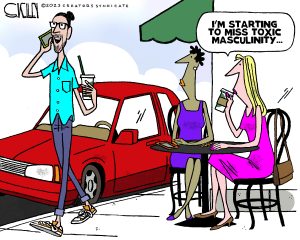
When men are constantly told that their natural inclinations are problematic, they rarely transform their behavior or move toward a new paradigm. Instead, they tend to withdraw. Many psychologists argue that the constant barrage of criticism has caused young men to simply bow out of the arena.
Instead of navigating a workplace or dating culture where they feel they are “walking on eggshells,” they retreat to safe, low-stakes digital spaces (like video games or online communities) where they aren’t judged for being competitive or aggressive.
In the newspaper article I mentioned at the beginning of this post, the author wrote: “The full feminization of the workplace is only a few decades old now, with every firm being lorded over by human resources, which is dominated by women; 70–80 percent of HR personnel are women. They serve as breeders of conflict such that any offense is immediately reported if it usually involves men as the target.”
The article went on to say that college students have been taught for years that the word “toxic” and masculinity are inseparable, while the phrase “toxic femininity” does not exist.
So, only men can be toxic? I seriously doubt that.
When I was the dean of the College of Media at the University of Illinois, I spent hours defending one of my best professors against a couple of female students who accused him of “toxic teaching.”
Apparently, the professor raised his voice in frustration in class one time too many, which triggered a sense of microaggression in the two fragile students. The charges they brought delayed the professor’s promotion from Assistant to Associate Professor for an additional six months while the Faculty Advisory Committee conducted an “investigation” of the male professor’s teaching methods.
Ultimately, via the Napoleonic justice system that prevails in academia today (i.e., you are guilty until proven innocent), the professor was deemed innocent and promoted to associate professor.
Is this an anomaly? Not at all in academia. And not in the workplace of 2026. It is all too commonplace for a man in today’s workforce to be falsely accused of sexual harassment or some other social absurdity. Few companies are willing to risk the costs of litigation, so they often throw the accused guy under the bus, even with little or no evidence of wrongdoing.
The newspaper article went on to tell of an executive at an investment bank who said that men in his office regarded women co-workers as “inanimate objects, like statues,” with whom they avoided engaging in any setting. The executive added that no man in charge would ever get into an elevator if there was a woman alone inside.
“Doing so risks your career because you can be accused of anything to your doom,” the executive said.
My first thought is this guy must be incredibly paranoid. Surely, he isn’t afraid to enter an elevator when the only other occupant is a woman. Then I remembered my faculty member and the academic Star Chamber ordeal he had to endure.
So, where are we today?
I don’t believe, as some do, that America is necessarily becoming a matriarchal society, but it is definitely moving away from the rigid, strictly defined paternal provider model of the 1950s that I reached puberty under.
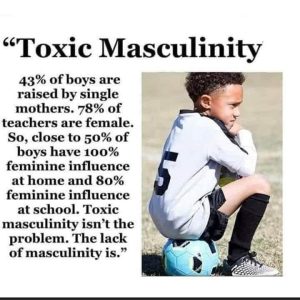
The generation of men who built the post-World War II economy operated under a clear blueprint: protect, provide, endure, and do not complain. Today, that blueprint has been dismantled, but a clear, widely accepted replacement has not been provided.
And therein lies the conundrum and challenge for today’s American men.
Combined with falling biological markers of vitality (like testosterone) and a restructured culture and society highly critical of male behavior, many men are experiencing an identity crisis—leaving them looking less like the decisive, family-anchored men of past generations, and more like a derisory male demographic that is adrift and purposeless.
So where are America’s men?
Are they still around, just less aggressive and toxic? Are we witnessing a “crisis in masculinity?”
Are traditional male traits—such as physical strength, stoicism, competitiveness, and assertiveness—being actively discouraged?
Have our institutional environments, particularly in K-12 education and corporate culture, become hostile to natural male behavior? Has the widespread push against “toxic masculinity” gone too far, mistakenly pathologizing healthy, traditional masculine drives?
It seems to me that men today are being conditioned to be passive and overly cautious, leading to a decline in male confidence, leadership, and resilience.
Ultimately, men are still around, but we are navigating a society undergoing a massive structural and cultural realignment.
Whether that realignment is at the cost of essential male virtues or a healthy widening of what it means to be a man depends entirely on the cultural framework you use to look at it.
–30–
If you enjoyed this post, please consider subscribing to ForeignCorrespondent and tell your friends to subscribe. “It’s free—what a deal!” If you’ve received this from a friend and would like to be added to our distribution list for future blog posts, simply enter your email in the notifications box to sign up:
https://ronaldyatesbooks.com/category/foreign-correspondent.
You can also find my commentaries on Substack at https://ronyates.substack.com/ and the American Free News Network at https://afnn.us.
Please feel free to comment: We genuinely love hearing from you!