
For decades, a sanitized, contemporary orthodoxy has sought to rewrite human history into a simplistic morality play starring one allegedly unique oppressor and a cast of permanent victims.
The latest casualty of this cultural revisionism is Eli Steele’s new documentary, White Guilt—a film that has drawn immediate, predictable fury from progressive commentators, left-leaning media outlets, and institutional gatekeepers.
The offense? The film dares to question whether contemporary society’s obsession with collective racial contrition is actually curing our social ills or simply weaponizing them.
But the backlash against Steele’s work points to deeper intellectual dishonesty in our public square: insisting on viewing history through a single, distorted lens. If we are going to assign moral blame based on the historical behavior of human tribes, we need to broaden our perspective far beyond the modern West. History is not a record of a single group’s singular cruelty; it is the universal, tragic chronicle of an ambitious, deeply flawed species.
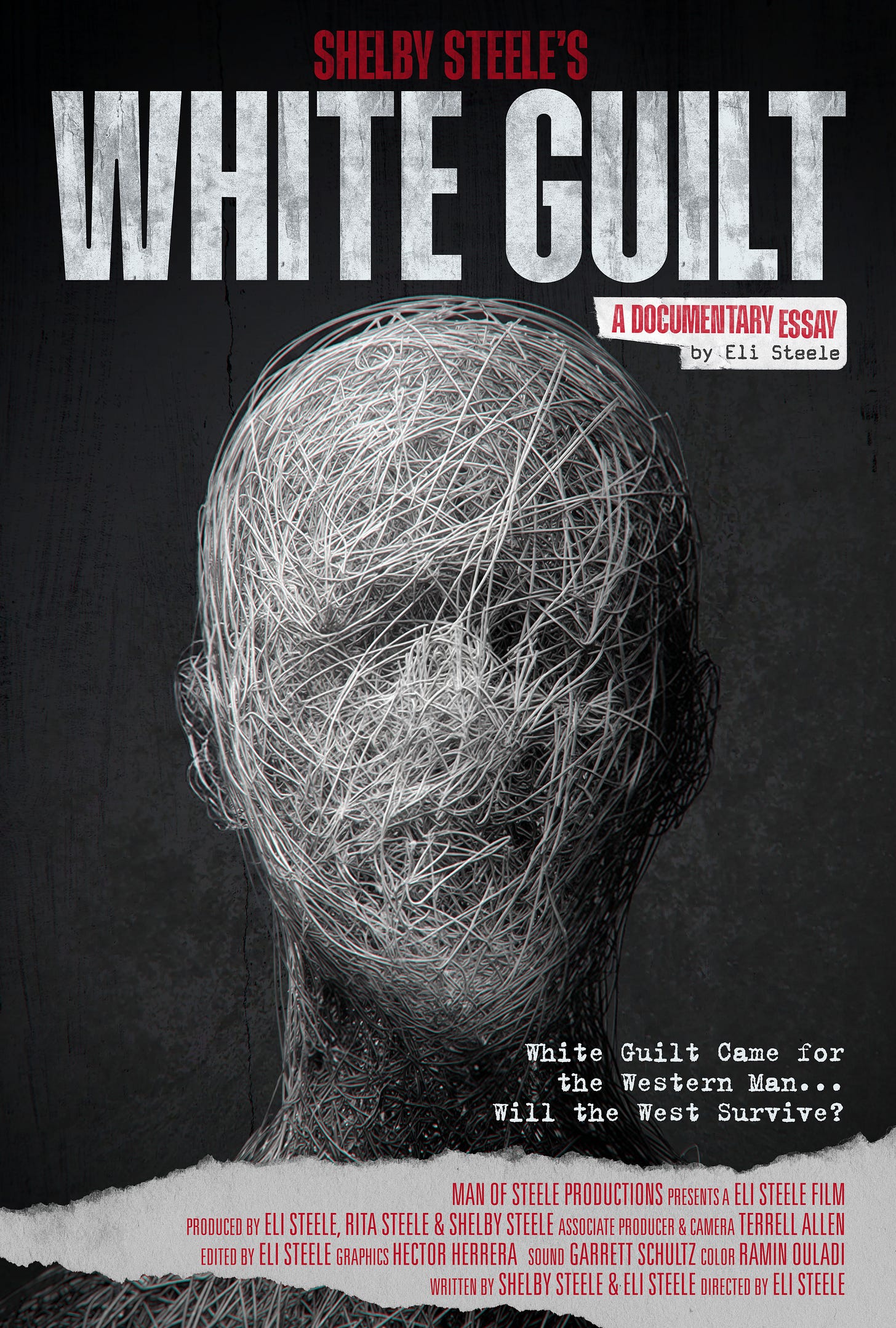
“White Guilt,” for those unfamiliar with the term, entered the American lexicon in the late 1960s—at the height of the Vietnam War, the civil rights movement, urban unrest, and the resulting fracturing of fragile American consensus and harmony.
Like a tenacious, malignant tumor, it has remained with us since, stubbornly resisting all attempts to remove it from the collective American consciousness.
Just what is it?
A rigorous and objective definition of “white guilt”—viewed through the lenses of sociology, cultural commentary, and intellectual history—is a psychological and moral burden experienced by certain individuals (mostly white) within Western societies, stemming from the historical atrocities and systemic injustices of slavery, colonialism, and racial subjugation.
It operates on the premise that contemporary members of a dominant racial group—regardless of their personal lineage, beliefs, or actions—bear a lingering moral stain or responsibility for historical wrongs committed by their forebears or institutions.
And therein lies the flaw.
Within public policy, corporate culture, and academia, white guilt frequently manifests as a defensive mechanism. Institutions seek absolution or moral legitimacy through preferential policies, diversity agendas, and symbolic public contrition, trading moral redemption for immunity from social criticism.

While civil rights leaders like Martin Luther King Jr. occasionally referenced the psychological and moral burden white Americans felt regarding segregation and racial subjugation, the concept shifted in the decades that followed. Scholars and social critics—most notably Shelby Steele in his seminal 1990 book The Content of Our Character and his subsequent 2006 book White Guilt: How Blacks and Whites Together Destroyed the Civil Rights Movement—crystallized the term as a political and cultural critique.
Ironically, as African American social and political historians like Shelby Steele have argued, white guilt often transforms into a patronizing dynamic. By viewing minority groups primarily through the lens of historical victimhood rather than individual competence and agency, it paradoxically reinforces the very hierarchies it aims to dismantle—treating minorities as permanent dependents requiring perpetual white oversight and institutional rescue.
That argument is at the heart of Eli Steele’s controversial new documentary, “White Guilt.” Eli, Shelby Steele’s son, is an independent documentary filmmaker, writer, and socio-cultural commentator. He has created a film that rips the heart out of the White Guilt perspective. He knows this trap well. Though he never publicizes it, he is black, Jewish, Native American, and deaf—in short, if anybody has the right to challenge the efficacy of the White Guilt polemic, Eli Steele certainly does.
Rather than working from inside academia’s traditional ivory tower, Eli Steele uses documentary film and long-form commentary to engage in the same cultural and political debates his father has spent decades writing about.

For his film, he spent three years traveling the country, listening to people’s stories and putting them on the screen. Predictably, leftists, socialists, communists, and Democratic socialists have attacked the film as racist and even white supremacist. Naturally, many of the people who have attacked the film have not watched a single minute of it.
Nevertheless, they have announced their verdict and quoted their requisite racial-justice authorities. You cannot challenge the White Guilt orthodoxy, and if you do, that makes you a white racist—even if you are black men like Shelby and Eli Steele.
Think about that.
Or better yet, let’s look at why the very concept of White Guilt is a deeply flawed historical and social story.
History chronicles empires rising and falling through conquest, displacement, and subjugation, across every continent, ethnicity, and skin color. To single out Western civilization or the Caucasian race as uniquely culpable for the universal human sin of tribalism requires a staggering historical blind spot.
Think about the tribalism of antiquity. The expansionist campaigns of the Mongols reshaped the Eurasian landmass through immense violence; African kingdoms engaged in tribal warfare and slave-trading long before and during the transatlantic trade; indigenous nations across the Americas frequently warred with and subjugated and enslaved rival tribes; and early Islamic conquests radically altered the Middle East, North Africa, and parts of Europe through ferocious and implacable military expansion.

Virtually every civilization, given the means and opportunity, has practiced power, domination, and cruelty.
So why the West’s unique self-flagellation? What makes “white guilt” a distinctly modern Western phenomenon is not that the West was uniquely brutal, but that it is uniquely obsessed with moral self-indictment. No other civilization in human history spends as much energy cataloging its historical sins, deconstructing its own foundations, and teaching successive generations to view their heritage through a lens of permanent moral failure.
By combining a rigorous takedown of how modern cultural narratives sanitize and distort history with my own experiences as a foreign correspondent watching human nature play out across continents and decades, I believe I’ve reached some valid conclusions about White Guilt.
Strip away the sanitized modern lens we project onto the past, and what is being sold today is not history but a political morality play. As a foreign correspondent, I have seen firsthand how power, tribalism, and conflict work in the real world, from the Iron Curtain to Asia to moments of revolution. Human nature does not change simply because today’s ideologues wish it would.
I see three logical reasons to reject the concept of White Guilt today.
First, the “unique” oppressor fallacy. Modern cultural narratives rely entirely on flattening history into a binary code of modern racial categories. By showing that conquest, subjugation, and tribal brutality are pan-human experiences belonging to every race and continent, you dismantle the premise that the West holds a monopoly on historical cruelty.
Then, there is the irony of selective guilt. Hyper-focusing on the historical sins of one specific civilization while ignoring or excusing the parallel, often identical, sins of countless other empires and tribes throughout time is profoundly intellectually dishonest. It treats history not as a complex, tragic human tapestry, but as a weaponized political tool.
Finally, my favorite—the cosmic perspective. Bringing in that outsider or extraterrestrial viewpoint is not only critical today, but also necessary, given the kinds of formerly classified documents our government is releasing to the public about non-human extraterrestrial beings and their enigmatic, incomprehensible airborne vehicles.
Looking down at Earth through a wide lens exposes the sheer absurdity of assigning collective, generational guilt to a single demographic when every tribe, tongue, and race on the planet has walked the exact same dark paths of power and conflict. In the minds of the aliens who may be watching us—or may be among us—does anybody believe that they would ascribe all the sins of the world to just one racial group after observing humans at each other’s throats for thousands of years?

Hardly. An objective cosmic or extraterrestrial observer looking down at Earth wouldn’t see a morality play starring one uniquely evil demographic and a cast of permanent saints. They would see a flawed, deeply tribal biological species repeating the same cycles of power, conflict, tribalism, and territorial impulse across every tribe, tongue, and nation.
By reducing history to a simplistic leftist cartoon of “oppressors vs. oppressed” based strictly on modern racial categories, contemporary cultural narratives rob individuals of personal agency and strip history of its messy, complex reality. Eli Steele’s documentary challenges this very orthodoxy, inviting audiences to step outside the trap of collective guilt.
In the end, modern narratives built on “white guilt” and selective historical outrage do not achieve justice—they achieve paralysis. By flattening millennia of complex human conflict into a cartoonish binary of modern racial categories, we rob individuals of personal agency and strip history of its messy reality.
If an objective, cosmic observer looked down on our species today, it would not see a world neatly divided into moral saints and unique villains. It would see a pan-human tapestry of tribalism, conquest, and power struggles echoing across every continent, language, and era.
Humanity has much to answer for, but the burden belongs to all of us—not to any single race, and certainly not to a contemporary generation of white human beings charged with apologizing for the ghosts of a shared past.
–30–
If you enjoyed this post, please consider subscribing to ForeignCorrespondent and tell your friends to subscribe. “It’s free—what a deal!” If you’ve received this from a friend and would like to be added to our distribution list for future blog posts, simply enter your email in the notifications box to sign up:
https://ronaldyatesbooks.com/category/foreign-correspondent.
You can also find my commentaries on Substack at https://ronyates.substack.com/ and the American Free News Network at https://afnn.us.
Please feel free to comment: We genuinely love hearing from you!