
There is hope for women’s sports—at last.
The IOC just announced a new policy that excludes transgender men (biological males) from the female category at the Olympic Games.
That means we won’t have to watch women getting pummeled and mauled by men claiming to be women in Olympic boxing or wrestling matches.
Even though the U.S. federal civil rights law known as Title IX has protected women’s sports in America since its passage in 1972, some states have ignored the law by allowing men to compete against girls and women in athletic contests, thus essentially neutering Title IX.
Now that the IOC has issued its definitive ruling, maybe those states that allow men to compete against women and girls—including California, where I reside—will come to their senses and follow the IOC’s lead.
Of course, when it comes to California, I’m not holding my breath. This state almost always defies common sense.
Of course, with the Olympics coming to Los Angeles in 2028, California will have no choice but to follow the IOC’s rules banning men from competing against women.
Here are the Key Details of the IOC Ruling:
- Biological Standard: Eligibility for the female category is now limited to biological females.
- Verification: The IOC will implement a mandatory, one-time SRY gene screening (the gene typically found on the Y chromosome) to determine eligibility.
- Scientific Basis: The IOC cited research showing that biological males retain significant performance advantages (10–12% in swimming/running and over 100% in “punching sports”) even after testosterone suppression.
- Scope: This policy will be fully implemented starting with the 2028 Los Angeles Games.
All I can say is thank God that those who lead the IOC have come to their senses. The IOC’s decision is decidedly significant because it aligns international standards with recent U.S. federal actions, specifically President Trump’s 2025 executive order, “Keeping Men Out of Women’s Sports.”
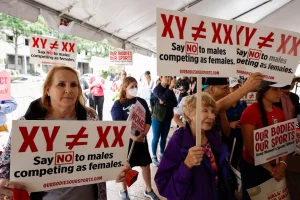
The ruling will impact several areas of women’s sports in America. First, it requires the US Olympic Committee to comply with IOC expectations, meaning U.S. Olympic hopefuls must now meet the biological female criteria to compete.
The ruling provides a legal and “gold standard” scientific precedent for the 27 states that have already banned trans athletes from women’s sports.
In states like California that still allow trans women to compete against biological women, the ruling creates a “dead end.” Athletes who qualify under state rules may find themselves ineligible for the national and international levels, likely increasing pressure on those states to align with the IOC and federal standards.
Under the current U.S. administration, schools or organizations that do not follow this biological standard risk having their federal funds rescinded under a new interpretation of Title IX.
Most importantly, the new IOC ruling effectively ends the “patchwork” of rules where individual sports federations (like swimming or track) had to create their own bans.
By setting a universal Olympic standard, the IOC has signaled that “fairness and integrity” in the female category are best protected by excluding biological males, a move supporters say will ensure that the opportunities created by Title IX are preserved for biological women.
As someone who played high school and college sports, I never had any doubt that male athletes would almost always beat women in sports that demand speed, strength, and physical attributes such as height (basketball, volleyball) and weight (football, boxing, wrestling).
Sure, there are always anomalies. Who can forget Billy Jean King defeating Bobby Riggs in a tennis match in 1973? Of course, in the famous “Battle of the Sexes,” which is what the King vs. Riggs match was called, King was in her prime at 29, and Riggs was 55—long past his competitive peak since winning Wimbledon and the U.S. Open in 1939.

King won in straight sets: 6-4, 6-3, 6-3, but afterward she acknowledged that she could not beat male tennis stars who were in their primes in 1973, such as Ilie Nastase of Romania or USA stars Jimmy Connors and Stan Smith.
Tennis is one thing; however, in major “power” sports like football, basketball, and track and field, physiological differences make direct head-to-head victories rare at the elite college and professional level.
Okay, my research found a few anomalies. Women have successfully competed against men in a few sports that emphasize accuracy, endurance, or skill-based precision. And there have been a few exceptions where women have broken into a few “major” male leagues.
For example:
- Basketball: Nancy Lieberman became the first woman to play in a men’s professional basketball league when she joined the Springfield Fame of the United States Basketball League (USBL) in 1986.
- Hockey: Manon Rhéaume became the first woman to play in the NHL when she suited up as a goaltender for the Tampa Bay Lightning in a 1992 preseason game.
- Baseball: In 2014, Mo’ne Davis became a national sensation when she pitched a shutout in the Little League World Series, becoming the first girl to earn a win and a shutout in the tournament’s history.
- Football: While no woman has played in the NFL, several have competed as kickers in Division I college football, most notably Sarah Fuller, who became the first woman to score in a Power Five conference game for Vanderbilt in 2020.
I say good on those women. But they were rare exceptions—very rare.
IOC president and former Olympian Kirsty Coventry appeared in an IOC video, explaining that the IOC’s new policy was “based on science” and had “the best interest of athletes at its heart.”

“Eligibility for any female category event at the Olympic Games or any other IOC event, including individual and team sports, is now limited to biological females,” the International Olympic Committee said, to be determined by a mandatory gene test once in an athlete’s career.
“At the Olympic Games, even the smallest margins can be the difference between victory and defeat,” Coventry, a two-time Olympic gold medalist in swimming, said in a statement. “So, it is absolutely clear that it would not be fair for biological males to compete in the female category.”
Coventry, the first woman to lead the Olympic body in its 132-year history, last June set up a review of “protecting the female category” in one of her first big decisions.
Good on Kirsty Coventry. Finally, an IOC leader who is operating on common sense, rather than caving to the cult of transgenderism. Maybe it took a woman—and a former female athlete—to finally end the transgender psychosis that has infected and attacked women’s sports for the past couple of decades.
Are there some areas where men and women can compete against one another in the Olympics and in other competitions?
Yes. As I mentioned earlier, women have successfully competed against men in a few sports that emphasize accuracy, endurance, or skill-based precision. For example, I found a few notable victories by women against men:
- Skeet Shooting: At the 1992 Barcelona Olympics, Zhang Shan made history by winning the gold medal in the mixed-gender skeet shooting event. She was the only woman to ever win an Olympic medal in this event before the IOC separated it into men’s and women’s categories.
- Horse Racing: In 1993, Julie Krone became the first female jockey to win a Triple Crown race, taking first place at the Belmont Stakes.
- Bowling: In 2010, Kelly Kulick became the first woman to win a title on the Professional Bowlers Association (PBA) Tour by defeating Chris Barnes in the Tournament of Champions.
- Ultramarathon: Pam Reed won the grueling 135-mile Badwater Ultramarathon as the overall winner in both 2002 and 2003, beating the fastest men in the field.
- Sailing: In 2005, Ellen MacArthur broke the world record for the fastest solo circumnavigation of the globe, beating the previous record held by a male sailor.
Once again. That’s great. I suspect women and men could compete against one another in curling competitions during the Winter Olympics. Curling requires great skill and accuracy, and unless that non-contact sport disintegrates into one in which contestants hurl the 42-pound curling stones at one another rather than sliding them on the ice, I suspect men and women will be just fine curling against one another.
If that did happen, I guess they would have to rename the sport curling hurling.
But I digress.
For all the women athletes out there, who no longer have to compete against bigger, stronger boys and men in Olympic sports, CONGRATULATIONS!
While I credit Kirsty Coventry of the IOC for her gutsy call to ban men from women’s sports and locker rooms, you really have to acknowledge key women athlete activists like former All-American swimmer Riley Gaines, University of Pennsylvania swimmer Paula Scanlan, former tennis legend Marina Navratilova, and Olympic silver medalist swimmer Sharron Davies of Great Britain for having the courage to stand up against the transgender mania that has gripped America and common sense for decades.

Former ESPN anchor Sage Steele has also been a prominent speaker at rallies against biological males in women’s sports, often appearing alongside athletes like Gaines at the Supreme Court to advocate for state-level bans.
Those determined and indomitable women risked their reputations and even physical attack to speak out against men playing women’s sports and inhabiting women’s locker rooms and other private spaces.
In addition to them, organizations such as the Independent Council on Women’s Sports (ICONS), Champion Women, and Women’s Liberation Front (WoLF), have also led the battle to keep transgender men from raiding women’s sports.
The constant pressure exerted by those women and organizations no doubt played a key role in moving the IOC to ban biological men from competing against women in the Olympics once and for all.
Good on them all! As the father of two girls (now women), I never had to watch my girls compete against men or boys in sports in the 1970s or 1980s.
Times were rational and sensible then. Men could not get pregnant or breastfeed children. Confused children’s genitalia were not being mutilated by doctors and hospitals without the knowledge of their parents. Men pretending to be women were not allowed to parade around naked, in locker rooms, or shower with women athletes.
And I didn’t have to watch a female boxer from Italy being pummeled and beaten senseless by a biological male Algerian boxer until she broke down in tears in the ring during the Paris Olympics. It was the most barbaric display I have ever seen in the Olympic Games—and I covered a couple of them during my career in journalism.
On that note, I will leave you with this short clip from Kirsty Coventry, who explains the IOC decision to ban biological men from women’s competitive events.
https://www.youtube.com/watch?v=Qw_eQFq3ILk
–30—
If you enjoyed this post, please consider subscribing to ForeignCorrespondent and tell your friends to subscribe. “It’s free—what a deal!” If you’ve received this from a friend and would like to be added to our distribution list for future blog posts, simply enter your email in the notifications box to sign up:
https://ronaldyatesbooks.com/category/foreign-correspondent.
You can also find my commentaries on Substack at https://ronyates.substack.com/ and the American Free News Network at https://afnn.us.
Please feel free to comment: We genuinely love hearing from you!

IX!