
Several months ago, I sent a note to Caroline Hendrie, Executive Director of the Society of Professional Journalists (SPJ), the 117-year-old organization that focuses on journalism ethics, defending the First Amendment, and providing professional development for both legacy and independent journalists.
I have been a member of SPJ for more than 50 years, since I was the editor of the University Daily Kansan, the student newspaper at the University of Kansas, so I figured I had earned the right to grumble and nag a bit about the wretched state of journalism in America today.
In that note to Ms. Hendrie, I lamented what I considered the SPJ’s failure to call out malpractice and bias in today’s legacy media. To her credit, Ms. Hendrie took the time to respond to my letter and clarified the SPJ’s position on the issues I raised.
Today, I am sending a new, much longer letter to Ms. Hendrie at the SPJ, which I have decided to share with followers and others who may be interested.
I hope you will read it and share it with others. In it, I express my concern about a new proposed law in California that would punish journalists who dare to expose government waste and fraud. That law (AB 2624), also known as the “Stop Nick Shirley Act,” has just passed through a California Assembly committee and is on the way to the Assembly floor, where the Democratic Party that monopolizes politics in California will no doubt pass it.
My letter is included below. Please take a look:
Dear Ms. Hendrie,
A while back, I sent you a short note questioning the SPJ’s seeming failure to analyze and censure the legacy news media’s betrayal of the journalistic ethics and standards SPJ so properly and earnestly promotes.
I mentioned that a Gallup poll recently found that the American public’s trust in our news media has plummeted to just 29 percent today, down from 72 percent when I joined the Chicago Tribune in the 1970s.
I appreciated your response to my note. I apologize in advance that this letter is a little (actually, a lot) longer than my last missive. Nothing has changed since our last correspondence. If anything, I think problems in the Fourth Estate are getting worse.
However, you mentioned attacks on the press and the need to protect journalists. I agree with you. A free and independent news media is critical to the health of a democratic republic such as ours.
I know I am preaching to the choir when I mention such things to you, Ms. Hendrie. Yet, here in California, we have a Democratic-controlled legislature attempting to pass new legislation designed to punish journalists who investigate government waste and fraud.
Opponents of the bill (AB 2624) have nicknamed it the “Stop Nick Shirley Act.” As you are probably aware, Nick Shirley is an independent journalist who has gained a large following for viral videos investigating alleged fraud and mismanagement in government-funded NGOs, phony hospice and childcare facilities, and fraudulent migrant service centers in Minnesota and California—many of which are operated by various criminal organizations and immigrants who entered the U.S. illegally.

The bill is formally framed as a measure to protect immigrant-serving organizations from “threats of violence” and harassment. However, it contains specific provisions that have drawn intense fire from free-speech advocates and independent journalists.
The bill would allow individuals affiliated with certain organizations (specifically those providing services to immigrants) to demand the removal of video recordings, even if those recordings were made in public spaces.
It also introduces the possibility of costly financial penalties—up to $10,000, according to critics—against those who publish such footage and refuse to take it down.
My question to you and the SPJ is simple. Have you or the SPJ spoken out against this brazen attack on press freedom? If not, will you?
If it passes, AB 2624 will be a deliberate violation of the First Amendment and press freedom, because it grants private entities the power to censor documentation of their activities (including potential waste or fraud) even when that documentation is captured in public view.
I am aware that some in our legacy news media are not supportive of independent journalists like Nick Shirley. During my 30-year career as a foreign correspondent with the Chicago Tribune, I occasionally ran into a few of them while on assignment. In those days, we called them “stringers,” and those of us in the legacy media tended to dismiss them as “unskilled amateurs.” In fact, I knew many stringers who were damned fine reporters—sometimes better than those who worked for major news organizations.
In today’s world of social media bloggers and podcasters, they are called independent or citizen journalists, and there are some excellent ones out there committing great journalism. I think the shift toward independent journalism as a primary vehicle for investigating government waste and fraud is one of the most significant structural changes in the modern media landscape. It reflects both a technological democratization of information and the emergent “trust gap” regarding traditional news media outlets.
There is a growing perception that our legacy media have become too closely aligned with the institutions and individuals they are meant to oversee. As a result, the “watchdog” function has waned considerably. What concerns me (and should concern SPJ) is that the rise of independent journalism has met with increasing legislative pushback, as we are seeing in California.

You and I both know that because independent journalists don’t always have the legal departments of a Chicago Tribune or CNN behind them, they are more vulnerable to targeted legislation and laws that redefine “harassment” or “privacy” to include filming in public. Such laws can effectively shut down independent oversight.
Large fines (such as the $10,000 penalties mentioned in the California bill) can be a nuisance for a billion-dollar media corporation but a “career-ender” for an individual reporter or independent journalist.
I’m not telling you anything that you don’t already know, but the fact is, we are moving—or have already moved—toward a bifurcated media environment. Legacy media remains the primary “Record of Note” for government policy, official declarations, and international events, while independent journalists have become the “Irregular Sentinels” of the digital age—venturing into areas the mainstream media won’t go, such as those “Learing” centers in Minneapolis.
While this brings considerably more diversity and independent thought, it also places a greater burden on news consumers to verify sources and cross-reference facts, because the traditional “editor” intermediary has been removed from the process.
I think the rise of independent journalists renders the public more informed, but I also feel the lack of a traditional editorial gatekeeper and oversight makes it harder to distinguish between impartial journalistic investigation and partisan political activism. In effect, we are trading institutional reliability for individual transparency.
The editorial gatekeepers in traditional newsrooms served as a critical filter. They provided a layer of protection against errors and libel, but that filter also functioned as a barrier, deciding which stories were “fit to print.” By removing the barrier, we’ve gained a flood of information, but we’ve lost the safety net.
For decades, journalism operated under the idea that a reporter should be a neutral, objective observer. That’s what I learned in the William Allen White School of Journalism at the University of Kansas. Of course, you and I know that such an impartial reporter is an allegory, rather than a fact.
I learned early on, as a general assignment reporter in Chicago, that it was up to me to harness my biases and rein in my predispositions when covering a story. Was I always able to do that? No, I wasn’t. I worked to keep my prejudices out of the copy I produced.
Independent journalists today argue that “neutrality” is often a mask for supporting the status quo. They tend to be “conviction journalists” who are open about their biases. This makes it easier to know where a reporter stands, but harder to trust them as a disinterested arbiter of facts. You aren’t just buying the news; you’re buying a perspective.
In addition to the questions of neutrality vs. perspective, we also face the conundrum of verification vs. velocity. At the Tribune in the “good old days,” a story might be held for days to secure a second or third source, followed by legal clearance.
When that happened, I wanted to pull my hair out (back then, I had more hair), waiting for that clearance because there were five competing newspapers in Chicago, and I didn’t want to get scooped by the Chicago Sun-Times, the Chicago Daily News, Chicago Today, the Daily Defender, or (God forbid) City News Bureau, which was no doubt the greatest training ground for reporters ever devised.
Reporters couldn’t leave the City News Bureau office on assignment without seeing a prominent sign over the door that said: “If your mother says she loves you, CHECK IT OUT!” Accuracy, checking, and double-checking facts were ingrained in CNB-trained reporters’ minds.
By contrast, an independent journalist today can post a clip or story the second it happens. This is great for exposing immediate fraud or waste (like the Nick Shirley videos that inspired AB 2624). But, without a legal department or an editor saying “wait,” the risk of spreading misinformation or incomplete narratives is much higher. We both know that once a viral “truth” is out there, corrections or retractions rarely travel as far as the original mistake—nor do they have the same impact.
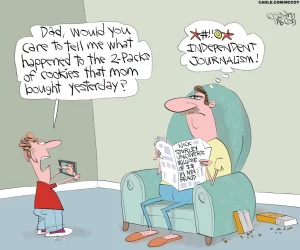
As we move from legacy media’s “trust me” model to independent media’s “verify me” model, we find ourselves in a news media twilight zone. The rules are changing, and so are the players in the “great game” called the Fourth Estate.
Independent operators such as Nick Shirley are doing journalism in a different way. What motivates these independent journalists remains to be seen. Are they motivated by the kind of objective truth-telling that motivated us traditional hacks, or are they packaging activism as objective truth? I suspect it might be a little of both.
Just as it was with those of us who began our careers in the Pleistocene age, when the news media were receiving a 72 percent approval rating from readers and viewers, the truth is in the eye of the beholder.
And that truth is coming from multiple sources today, including independent journalists like Nick Shirley.
I suspect Nick will never win a Pulitzer or an Emmy for his work, though I believe the impact of his work in Minnesota and now in California certainly deserves recognition from local press clubs or even by the Society of Professional Journalists. His work exposing rampant waste and fraud in Minnesota and California has been immensely impactful and meaningful, regardless of what Democratic Assemblymember Mia Bonta says. (Bonta, the wife of California Attorney General Rob Bonta, is the author of the “Stop Nick Shirley Act.”)
Journalists are not licensed practitioners like lawyers or doctors, but they perform a critical role in our republic, whether they be “professional” legacy journalists or unfettered ones such as Nick Shirley.
Thank God we are not licensed. The fact that we aren’t enables us to practice journalism openly and freely, the way the Founders intended when they guaranteed a free press and free speech in the First Amendment of the Bill of Rights.
Nick Shirley deserves to be protected by the First Amendment just as I was when I roamed the world covering war and mayhem, or just as my students were when they produced the Daily Illini Newspaper when I was a professor of journalism and dean of the College of Media at the University of Illinois.
Ms. Hendrie, you hold an important position as the Executive Director of SPJ. And so does Nick Shirley as he puts life, limb, and reputation on the line to investigate waste and fraud in government. I hope the SPJ will publicly recognize Nick and support him as he fights the good fight in the face of mounting opposition and hostility. God knows, journalists today, whether legacy or independent, need all the support they can get. I have never seen journalists facing such vitriol and disparagement from the public and elected officials as they do today.
If the “Stop Nick Shirley Act” is passed by the California Assembly and signed into law by Gov. Gavin Newsom, it will have a chilling effect on all journalists—independent or mainstream. The “Stop Nick Shirley Act” will essentially be the “Stop all Journalists Act.”
For that reason, if for no other, I hope the SPJ will weigh in and oppose this dangerous bill.
Thank you for listening.
Respectfully,
Ronald E. Yates
–30–
If you enjoyed this post, please consider subscribing to ForeignCorrespondent and tell your friends to subscribe. “It’s free—what a deal!” If you’ve received this from a friend and would like to be added to our distribution list for future blog posts, simply enter your email in the notifications box to sign up:
https://ronaldyatesbooks.com/category/foreign-correspondent.
You can also find my commentaries on Substack at https://ronyates.substack.com/ and the American Free News Network at https://afnn.us.
Please feel free to comment: We genuinely love hearing from you!
As a kid living in the WDDC area (long before The Beltway), I had two newspaper routes—before school, the Washington Post; after school, the Evening Star. After my daily deliveries, I read both papers front to back (skipping the classified sections). Even as a kid, I realized the papers put different slants on the reportage. (I was too naive to think of it as political.) We need a variety of information sources. Years later (but now half a century in the past), the old USSR tried to discredit reporters who lacked official (government-sanctioned) status. I hope somebody at SPJ can dredge up the institutional memory and rise to the defense of press freedom.