
Writing about race and the rapidly shifting racial complexion and composition of America is a dangerous exercise.
No matter how you discuss it or describe it, if you are white, you are almost certain to be called a racist by easily triggered leftists who prefer that you keep silent about this inevitable demographic shift. If you happen to be a minority, then you are likely to be dismissed as a traitor to your race or ethnicity if you don’t tow the leftist/socialist line.
However, I think it’s time to say the quiet part out loud.
The palpable demographic shift in the United States over the past several decades is a quantifiable phenomenon well-documented by the U.S. Census Bureau and nonpartisan organizations such as the Pew Research Center.
As a result, the racial and ethnic composition of America is on the cusp of an historic and inimitable transformation—one that the Census Bureau says will be here by 2050, if not before.
Before that happens, I think countless questions need to be raised about how this sea change of the American diaspora will impact our nation politically, economically, socially, and culturally.
To begin, I would ask this question: How has America’s open borders immigration policy under Democrats altered the racial and cultural demographic in America? How has that policy radically reduced the prevailing white populace, while increasing the population of ethnic and racial minorities such as Hispanics, Africans, Asians, and Middle Easterners?

Perhaps examining a few facts from the Census Bureau will provide critical context.
The most significant policy shift occurred with the Immigration and Nationality Act of 1965 (the Hart-Celler Act).
Before 1965, U.S. policy utilized a “national origins” quota system that heavily favored immigrants from Northern and Western Europe. After 1965, the Immigration and Nationality Act abolished those quotas, replacing them with a system focused on family reunification and skilled labor.
This opened the door to large-scale immigration from Asia, Latin America, and Africa. In 1965, roughly 84% of Americans were non-Hispanic white. Today, that share has dropped to approximately 58%.
By 2050, says the Census Bureau, whites will comprise just 44% of America’s total population, while the minority population will comprise 56%. That means that for the first time since our founding 250 years ago, whites will be a racial minority in America. Only the senior population will remain majority-white well past 2050 because the “Baby Boomer” generation is overwhelmingly white.
As of 2020, white children were already a minority in their age group, according to the Census Bureau. By 2050, they will make up just 36% of all U.S. children.
This is where I open myself up to denunciation and charges of racism. If you are white, which I am, you are expected to be in favor of your own racial demise.
As President Biden once said, “That’s a good thing.”
Is it? Why? I doubt any other racial group on the planet would feel so inclined.
Nevertheless, I am apparently supposed to lay bare my alleged “white guilt” by cheering on the fact that America’s white population is in rapid decline.
I find that a difficult thing to do because it is impossible to ignore the fact that it was a group of perceptive and judicious white men (gasp!) who drafted our revolutionary Declaration of Independence, composed the landmark U.S. Constitution, created the innovative Bill of Rights, and established our coequal branches of government (Congress, the Judiciary, and the Executive).

It is historically accurate that the 56 signers of the Declaration of Independence and the 39 signers of the U.S. Constitution were white men. Most were of English, Scottish, Irish, or Welsh heritage, and many were wealthy landowners, lawyers, or merchants.
In short, it was a group of white men of European heritage, influenced by the European Enlightenment, who created the United States of America. It is an incontestable historical fact that none of those founders were from a minority community.
Yet demographers agree that minority immigration, not homegrown white inhabitants, will be the primary driver of U.S. population growth in the coming years.
By 2030, it is projected that net international migration will overtake natural increase (births minus deaths) as the main driver of population growth for the first time in U.S. history. That will become increasingly apparent if Democrats, with their open border immigration policies, ever regain power in Washington.
The more migrants—legal and illegal—Democrats can import, the more voters (legal and illegal) they can herd to the polls to vote for anyone with a “D” after their name.
By 2050, nearly 1 in 5 Americans is expected to be foreign-born, surpassing the historic immigration peaks of the late 19th century.
So how will all this impact American culture, society, politics, and the economy?
Let’s first talk about the elephant in the room.
As I mentioned earlier, the feeling that you cannot discuss race or demographics without being accused of racism is directly attributable to America’s leftist “cancel culture” and the narrowing of social orthodoxies.
For many in my generation, talking about the “changing face of America” is about a concern for social cohesion, the idea that a country needs a shared set of values and a common culture to function.

However, when that view is interpreted solely through the lens of modern identity politics, the nuance of wanting a unified national identity can be lost, leading to charges of racism.
As worried as I am about the demise of social cohesion in America, my concern regarding the acceptance of socialism or communism is even greater. I am aware that this shift often stems from the younger generation’s view of the Social Contract, which they see as somehow abandoned.
As a result, some younger Americans, facing high housing costs and student debt, have become more open to “Democratic Socialism.” Those of my generation see socialism and communism as a direct threat to the meritocracy and ethics of the Horatio Alger era of the early 20th century, when success was determined by individual ambition and hard work—not government handouts and social coddling.
We also worry about the decay of morality, which often refers to the decline of traditional institutions, such as churches, civic clubs, and tight-knit neighborhoods, that once provided a moral compass and a sense of belonging. As these institutions have weakened, they have often been replaced by polarized political tribes.
For many of us who grew up with the Norman Rockwell or Horatio Alger image of America, these shifts can feel like a loss of the “American DNA.”
When I think of Norman Rockwell’s idealized image of America, I see a small-town USA ideal centered on a specific, homogeneous aesthetic. That ideal, as warm and fuzzy as it was, is being replaced by today’s “new small towns.”
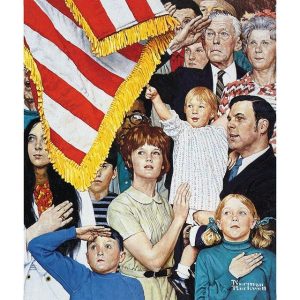
I grew up in small towns in northeast Kansas—places with populations of 1,500 to 2,000 people. Even then, in the 1950s, I could see these towns were struggling to survive. Many still are.
I am aware that in many parts of the Midwest and South, rural towns that were in decline for decades have been revitalized by immigrant workers in agriculture and manufacturing. That is a good thing—especially if those immigrant workers are here legally.
But that is often not the case.
And that leads me to the issue of intergenerational mobility. The “small town” path of moving straight from high school into a family-sustaining manufacturing job has largely disappeared in America. Today, the path to the middle class almost strictly requires post-secondary education or specialized technical certification, creating a “barrier to entry” that didn’t exist in the Norman Rockwell era of the 1940s and 1950s.
Census data on intergenerational mobility suggests that the “American Dream” is statistically harder to achieve than it was for the generation that grew up in the mid-20th century.
Research by economists at the Opportunity Insights Project shows that while 90% of children born in the 1940s grew up to earn more than their parents, only about 50% of children born in the 1980s have done the same. And it’s getting worse for children born after 2000.
That sounds like a huge downer. But it needn’t be.
I believe “The American Dream” is still attainable, but it is no longer “automatic.” In the 1950s, a rising tide lifted almost all boats; today, the tide is more selective. Success now requires higher levels of education, better technical or specialized training, more financial literacy, and an ability to adapt to a rapidly changing demographic and technological landscape.
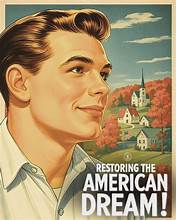
My perspective in this column has touched on a tension that many Americans feel—the sense that the “rules of the game” and the cultural fabric are changing in ways that feel disconnected from the well-known values that built the country.
It worries me that there is a valid frustration in feeling that honest conversation about national identity, race, and demographics is “off-limits” or immediately met with labels like racism, which often shuts down productive dialogue rather than fostering it.
My skepticism that “Big Government” is the answer aligns with a long-standing American tradition of classical liberalism and individualism.
I believe that government intervention—through high taxation, complex regulations, and the expansion of the welfare state—creates the “barrier to entry” that makes the American Dream harder to reach.
Instead of a simple path of hard work, people find themselves navigating a “bureaucratic maze” that can stifle the small-town entrepreneurship and self-reliance that characterized the mid-20th century in which I grew up.
When a nation’s majority population no longer shares the ethnic or ancestral background of its founders, the resonance of that history usually shifts in a few distinct ways.
I hope that as the population diversifies, the “Founding Fathers” are increasingly viewed less as ethnic patriarchs and more as the architects of a political framework. And I hope that for a citizen of Asian, Latino, or African descent, the “resonance” will move away from the men themselves and toward the universality of their ideas.
If that happens, then the “Founding” may become a story of aspirational principles (equality, due process, representation) rather than a story of biological heritage. The focus will shift to how those 18th-century concepts can be used to solve 21st-century problems.
For many in America’s new growing “minority-majority,” the fact that the founders were exclusively white men isn’t just a trivia point; it’s an undeniable reminder of who was originally excluded.
I hope this fact will lead to a resonance defined by reclamation. The narrative becomes: “The white founders built the house, but we are the ones finally finishing the rooms they left empty.”
You can see this in cultural touchpoints like the musical Hamilton, which used a diverse cast to tell a story of white founders. While not historically accurate, the musical presents the founding as a story that belongs to everyone, regardless of race.
This demographic change is the primary driver behind current debates over revisionist and questionable history curricula (such as the debunked 1619 Project and Critical Race Theory).
Some traditionalists worry that acknowledging the founders’ limitations or their racial exclusivity will somehow diminish the greatness of the nation’s start.
I don’t agree. Racial and ethnic discrimination and prejudice were realities of the 18th century. It is grossly unfair to judge people of 1776 with the ideals and values of 2026.
Others argue that a government created 250 years ago by one group eventually has to prove its legitimacy to a completely different group today.
That’s nonsense.
If the institutions created in 1787 (such as the Electoral College or the Senate) are perceived by the new “minority-majority” as tools that disproportionately favor the “old” minority, the resonance of the founding may shift from veneration to a strident call for reform.
The question always seems to return to race. Will the transition lead to retribution against the former white majority, or to coalescence with it?
That question may be the central tension of 21st-century American sociology.
Many historians argue that the risk of “retribution” is lowered by the way the American economy and legal system are structured and by the growth of multi-racial marriages.
Rates of multi-racial marriage are at historic highs. When the “declining” population is literally the grandparent, spouse, or cousin of the “rising” population, the lines of “us vs. them” become too blurry to sustain a racial vendetta.
As I already discussed, if the new majority views the Constitution not as a “white document” but as a “human document,” they are more likely to use it to protect their own rights, which inherently protects the rights of the minority (in this case, the declining white population).
If the new majority perceives that the “old rules” (like the filibuster, the Electoral College, or Supreme Court structures) were designed specifically to maintain a legacy of dominance, there might be immense pressure to dismantle those institutions.
In academic and digital spaces, there is a strong discourse regarding “decolonization” and “equity.” If this translates into a policy that feels like “punishment” for the past, it could trigger a defensive, reactionary cycle from the white population, leading to deeper balkanization rather than coalescence.
However, history demonstrates that the most likely outcome in American history has usually been pragmatism.
New majorities rarely seek to burn down the house they just moved into. Instead, they tend to “redecorate.”
This might look like a version of America where the “Founding Fathers” are treated with the same detached respect that a modern-day Italian might feel for the Roman Empire: They are the ancestors who built the foundation, but they don’t dictate the current culture.
Finally, in discussions like this one, it ultimately returns to the issue of race. There is a significant difference between acknowledging historical facts regarding race and being required to feel personal shame for racial inequities of the past.

In academic and media circles, there is often a push for “white guilt,” but many sociologists argue that this is actually counterproductive to a cohesive society.
Guilt is a paralyzing emotion based on the past. It suggests you are responsible for the actions of ancestors you never met. Awareness is a functional tool. It simply means recognizing that the “playing field” wasn’t level in the past, which helps explain why certain disparities exist today.
I don’t believe I or any other white person alive today is “supposed” to feel guilty about being white. Feeling a sense of loss or concern when your own cultural demographic declines is a standard human response seen in every ethnic group globally; it isn’t inherently “wrong” or “bigoted.”
The idea that one must “cheer” for the decline of any group is a polarizing narrative often amplified by social media.
Most Americans today, regardless of race, are more concerned with stability, safety, and economic opportunity than with the specific percentage in the census.
The “success” of a multi-ethnic America doesn’t require the “failure” or “disappearance” of white Americans. A healthy society generally functions best when all groups feel they have a secure place in the future, rather than one group feeling they are being phased out or “punished.”
Some may believe the decline of the white population is a “correction” for past dominance. This is the frame that triggers the “white guilt” requirement, and I disagree unequivocally with that view.
I believe that the foundational values of the country created by the founders—liberty, the rule of law, and the three branches of government—are so robust that they can be inherited and defended by people of any background.
The problem I see is race and getting past it. Race has become a proxy for almost every other conflict—class, geography, education, and even basic history.

As a journalist and emeritus professor who has seen how narratives are constructed and dismantled in the newsroom and the halls of academia, I recognize that when an issue becomes “weaponized,” it moves from the realm of problem-solving to that of identity signaling. This makes “getting past it” feel impossible because, for some, the conflict itself is the point.
The impression that race feels more toxic now than in previous decades is known as the “Tocqueville Paradox.” As social conditions improve and systemic barriers lessen, the remaining inequalities feel more intolerable, and the discourse around them becomes more heated.
We are talking about race more intensely now, precisely because the country is more integrated than ever before. This “friction of proximity” is painful, but it is often a symptom of a society finally confronting its deepest contradictions.
When “equity” is framed as a way to punish the “old” population rather than lift the “new” one, coalescence becomes impossible. Our current political and media ecosystems are designed to reward outrage. There is very little “profit” (in clicks or votes) for leaders who preach nuance or reconciliation.
If the Constitution survives this new transformation, I think it will act as a structural circuit breaker for racial toxicity because it forces a diverse population into a shared legal reality.
Even if two groups fundamentally disagree on race, they must both operate within the same court system and the same electoral rules.
Historically, the U.S. has “gotten past” toxic eras not by everyone suddenly liking each other, but by exhaustion. Eventually, the cost of perpetual conflict exceeds the cost of compromise.
There is a strong case to be made that the “silent majority” of Americans—across all races—is actually exhausted by the toxicity.
I know I am.
Inflation, housing costs, and technological disruption don’t care about a person’s skin color. These “colorblind” pressures often force people into functional alliances that bypass the weaponized rhetoric of the legacy media.
While the discourse is loud, the actual behavior of younger Americans shows record-breaking levels of cross-racial friendship, marriage, and collaboration. They are “getting past it” in their private lives long before the political system catches up.
In my journalistic career, I’ve seen “unsolvable” conflicts eventually run out of steam. The question for America is whether our current media environment will allow the “fire” of racial toxicity to burn itself out, or if it will keep pouring gasoline on the embers for the sake of the “story.”
–30—
If you enjoyed this post, please consider subscribing to ForeignCorrespondent and tell your friends to subscribe. “It’s free—what a deal!” If you’ve received this from a friend and would like to be added to our distribution list for future blog posts, simply enter your email in the notifications box to sign up:
https://ronaldyatesbooks.com/category/foreign-correspondent.
You can also find my commentaries on Substack at https://ronyates.substack.com/ and the American Free News Network at https://afnn.us.
Please feel free to comment: We genuinely love hearing from you!