
Here’s a question for you: Can a nation so bitterly divided reunite and enjoy its 250th birthday this July 4th?
Here’s another: Is patriotism in America dead—a quaint relic of another time when Americans (both Democrat and Republican) were proud of their country?
And here’s one more: Just what is patriotism, and what does it mean to be patriotic in a nation where half the country despises and possibly actually hates the other half?
The answers to each of these questions cannot help but be controversial, and I am sure there will be many who will disagree with my attempts to settle them, but with our 250th birthday just around the corner, I feel compelled to try.
One of the first things I learned as a member of my high school debate team was to define terms before we began a discussion. So, before we look at whether patriotism is dead, we have to understand what it actually is—and, just as importantly, what it isn’t.
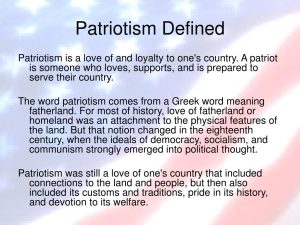
In essence, there are two conflicting definitions of patriotism at work in our country.
What we are witnessing isn’t necessarily a divide between love and hate, but rather a clash between two entirely different cultural definitions of national pride—conditional and unconditional.
 For most Republicans, patriotism is often treated as an unconditional virtue. It is anchored in a reverence for timeless symbols (the flag, the Constitution, the military) and the foundational concept of American exceptionalism. To express anything less than great pride is seen as a betrayal of the nation’s core identity.
For many Democrats, expressions of pride are highly conditional and tied to the country’s current moral or social trajectory. When they look at the country and see systemic inequities, a rollback of rights, or political leadership they disagree with, they express a lack of pride as a form of protest. In their view, true patriotism isn’t celebrating America as it is but critiquing it so it can become what it ought to be.
Historically, people can deeply love the culture, the land, and the ideals of their nation while utterly detesting its current government or political climate. That was the case during the four years of Joe Biden’s administration, and it is the case now in the middle of Donald Trump’s presidency and the wave of Trump Derangement Syndrome that seems epidemic on the left.
When a poll asks, “Are you proud of America today?” respondents aren’t just answering about the flag—they are venting their frustration about the current administration, the economy, or the cultural zeitgeist. Ditto, during the disastrous Biden presidency.
The tragedy of our current political moment is that we have weaponized these two definitions. The Left looks at unconditional pride and calls it blind, dangerous nationalism. The Right looks at conditional pride and calls it ungrateful, treasonous hatred.
But I would argue that a healthy nation needs both—or at least elements of both. Unconditional patriotism or pride gives us our baseline identity, the glue that holds us together. Conditional patriotism or pride gives us our conscience—the engine that drives us to improve.
It’s when either of these two concepts exceeds the boundaries of equanimity and rationality that things go off the rails.
When we look at public opinion data through that specific lens, it describes a truly staggering emotional divide. However, as an analyst looking closely at how these polls are constructed, I see a slightly different—and perhaps more complex—story behind those stark numbers.
 The idea that 71% of a major political party “hate” the country assumes that a lack of traditional pride equals active animosity. But when pollsters dig deeper into why that 71% answers the way they do, the narrative shifts from “hatred” to a fundamental disagreement over what patriotism actually means. (See Part One of this series of posts)
I have concluded that there are three distinct flashpoints—spanning history, cultural symbolism, and the civic arena—that illustrate where conditional and unconditional patriotism collide. Using these flashpoints seems to me the most effective way to anchor these definitions in the real world.
The first flashpoint is our history, the founding legacy. How we view the nation’s origins is perhaps the deepest, most contentious track in modern America.
The unconditional or conservative view focuses on the brilliance of the Declaration of Independence and the Constitution, the boldness of the Founders, and the revolutionary idea of God-given individual rights. To this mindset, America’s founding is a monumental achievement that deserves reverence. Focusing too deeply on the Founders’ flaws risks tearing down the very foundation of our liberty.
The conditional view focuses on the paradox at the heart of 1776—that a nation proclaiming “all men are created equal” was built by men who owned slaves and displaced indigenous populations. To this mindset, patriotism requires staring directly into that hypocrisy so the nation can actively work to fix its lingering systemic effects.
Flashpoint number two is our symbols—the National Anthem & The Flag. The debate over how to behave during the national anthem is a classic example of these two philosophies talking past one another.
The unconditional or conservative interpretation sees the flag and the anthem as sacred symbols representing the ultimate sacrifices made by generations of soldiers to keep the nation free. Kneeling or refusing to stand for either is viewed as a direct insult to those veterans and a rejection of the country itself.
The conditional or leftist interpretation sees the flag as a representation of the nation’s current moral state. Kneeling during the anthem is not intended as an insult to veterans, but as an act of dissent meant to highlight where the nation is failing to deliver “justice for all.” To the left, using a First Amendment right to protest is patriotic.
Flashpoint number three scrutinizes the concept of dissent or civic action.
When the nation enters a controversial conflict or faces internal strife, the definition of a “good citizen” splits down the middle.
The unconditional or conservative perception emphasizes solidarity, law and order, closed or tightly controlled borders, and standing by the nation’s institutions and leadership in times of crisis. The belief is that public fracturing weakens the republic from within and makes us vulnerable to enemy propaganda or even attack.
The conditional perception embraces the famous adage that “dissent is the highest form of patriotism.” Those on the left believe that a citizen’s duty is to actively challenge the government when it is wrong, and that blind compliance is actually a betrayal of democratic ideals.

When we look at these competing flashpoints, I find myself wondering if the division isn’t between those who love America and those who hate it. The division is between two entirely different modes of love.
Some of my friends on the right might say that assumption is a sellout to the left, while those left of center would no doubt argue that those on the right have a warped sense of love.
This post doesn’t intend to decide who is right or wrong. God knows, I have neither the universal insight nor the infinite wisdom to draw any unmovable conclusion.
However, as we approach our 250th birthday in a few days, the question isn’t whether we can force one side to surrender to the other. The question is whether we can be mature enough as a people to accept that a nation needs both the bedrock of unconditional pride to hold us together and the friction of conditional pride to push us forward.
And that brings me to another question that I often hear: Is patriotism in America dead? I don’t believe it is dead, but it is undeniably fractured and under immense strain. As discussed earlier, what once felt like a unifying cross-partisan consensus has morphed into two distinct, often conflicting narratives.
If it isn’t dead, then why does patriotism feel like a relic compared to the era in which I grew up? As an elementary and middle school student, I remember how every class began with the entire class standing and reciting the Pledge of Allegiance to the American flag, which was stationed in every classroom.

Today, I am not even sure if the American flag is in our classrooms, let alone that students are required to recite the Pledge of Allegiance.
Okay, I am aware that the era I am recalling—where Democrats and Republicans shared a palpable, unblinking pride in the nation—was largely forged by clear, external existential threats: World War II, the Cold War, and even the immediate aftermath of 9/11. When a nation faces a singular external adversary, internal fractures are set aside.
Today, the “threats” are increasingly viewed as internal. When political opponents view each other not just as people with different ideas but as existential threats to the republic, the shared foundation of patriotism crumbles. It may appear dead. But is it?
Patriotism isn’t dead, but it is competing with itself. Allow me to explain.
Millions of Americans across the political spectrum still love their country deeply. They show it when they vote, when they serve in the military, when they volunteer in their communities, and when they argue passionately about its future.
The tragedy of modern American civic life is not a lack of love for the country, but the inability to recognize that same love in our political opponents. When the left condemns conservatives for being fascists or Nazis, or when the right says the “other side” is communists who hate America, we lose the very thing that makes the American experiment possible: the belief that a majority of us are, ultimately, on the same team trying to form a “more perfect union.”
Even more relevant, however, is the fact that these terms are rarely used in their precise historical or ideological contexts. Instead, they are deployed as rhetorical weapons designed to shut down debate, strip away legitimacy, and trigger emotional, tribal reactions.
For either side, responding effectively requires shifting the ground from emotional provocation to intellectual precision, historical accuracy, and a defense of core principles.
So, how can conservatives answer the “Fascist” or “Nazi” label? And how can those on the left respond to charges that they are clueless “Socialists and Communists?”
To answer both questions with any authority at all, I dug through my notes from a political science class I took at the University of Kansas, my alma mater. Here is what I found after struggling to read my cursive notes and abridging them to fit the relevant issue.
The accusation that modern conservatism is synonymous with fascism or Nazism usually stems from a conflation of nationalism, populist rhetoric, or a desire for strong borders with totalitarian control. Conservatives can dismantle this charge by highlighting the fundamental, structural contradictions between conservative philosophy and totalitarian ideologies, which are what both Fascism and Nazi-ism are.
The defining characteristic of both Italian Fascism and German National Socialism was an all-powerful, centralized state. As Benito Mussolini famously summarized: “Everything in the State, nothing outside the State, nothing against the State.” In stark contrast, modern American conservatism is explicitly rooted in limited government, decentralization (federalism), and individual liberty. A philosophy that seeks to reduce the power, spending, and regulatory reach of the federal government cannot logically be equated with a Fascist or Nazi totalitarian state.
Fascism relies on the destruction of institutional checks and balances to concentrate power in an autocratic executive. Conservatives can point to their foundational defense of the U.S. Constitution, the separation of powers, and the protection of the Bill of Rights—especially the First and Second Amendments—as the ultimate bulwarks against tyranny and autocracy.
Nazism was a hyper-collectivist ideology built on racial identity and state supremacy. Conservatism evaluates individuals based on their character, merits, and God-given rights, rejecting the collectivist framework that subordinates the individual to the collective group or the state.
So what about Liberals and Progressives? How can they defend themselves against charges of communism? (Note: I want to be fair here, so I am providing valid advice for those on the left)
The accusation that the modern left consists of “communists” who want to destroy the republic usually conflates social democracy, progressive taxation, or government-led social safety nets with Marxist-Leninist totalitarianism. Liberals and progressives can counter this label by clarifying their commitment to democratic institutions and regulated capitalism.
True communism demands the abolition of private property, the total state ownership of the means of production, and a one-party dictatorship. The modern American left mostly operates within a capitalist framework. There are exceptions, of course. (New York Mayor Zohran Mamdani has famously and fitfully called for collectivism and the abolition of private property.) However, the goals of most liberals mirror the regulated market economies and robust social safety nets found in Western Europe (such as Scandinavia), where private enterprise thrives alongside public investments in healthcare, education, and infrastructure.
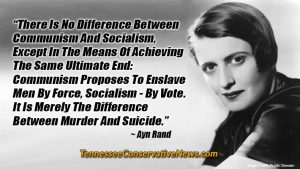 Communism historically achieved power through violent revolution and maintained it by suppressing dissent and eliminating free elections. Progressivism seeks change through the democratic process—expanding voting access, grassroots organizing, and legislative reform. The objective is to make the existing republic more inclusive and responsive to its citizens, not to overthrow it. At least, that’s how I have come to view it after rationally considering leftist arguments.
Rather than seeking to destroy the republic, the left can argue that policies addressing economic inequality, corporate monopolies, and climate change are designed to preserve and strengthen it. From this perspective, a stable republic requires a strong middle class and equal opportunity, which most leftists I know believe are protected by smart governance.
I know this summary will not please everyone on the right or the left, but I hope it resonates with a few. If nothing else, I hope it provides those on either side with a bit of ammunition to respond to an attack on their political positions.
To that end, here are a few tips I learned from my debate team days. Regardless of which side is being attacked, the most powerful response to extreme labeling is to refuse to play defense on a false premise. Instead of getting bogged down in a cyclical shouting match, an effective communicator can use a three-step framework to elevate the conversation:
First, reject the premise calmly. Explicitly state that the label is historically inaccurate and intellectually lazy.
Second, define your actual principles. Clearly articulate what you actually stand for (e.g., “I believe in free enterprise, limited government, and individual liberty” OR “I believe in regulated markets, social investment, and expanding democratic access”).
Finally, demand specifics. Force the accuser to move past slogans. Ask: “What specific policy that I support do you believe is fascist/communist, and why?”
When you steer the conversation away from incendiary historical catchphrases and back toward concrete policy, constitutional principles, and the mechanics of governance, the hyper-partisan labels quickly lose their sting.
As the nation approaches its 250th birthday, I am still wondering whether a nation as divided as ours can ever reunite.
The good news is that the U.S. has survived deep, venomous partisan divides before and emerged stronger and more united:
- The 1790s: The battle between Federalists and Jeffersonian Republicans was so intense that politicians openly accused each other of treason, weaponized the press, and passed the Alien and Sedition Acts to silence dissent.
- The 1860s: The obvious breaking point over slavery—a hot civil war that cost hundreds of thousands of lives before the Union was eventually restored.
 The 1930s: Deep class and political warfare during the Great Depression, during which some Americans openly called for fascist or communist dictatorships to replace a stalled democracy.
- The 1960s/70s: This is the one I am personally familiar with. Assassinations, race riots, bombings, and massive, violent, and sometimes deadly protests over the war in Vietnam. Frankly, I have never seen our country so divided—not even now.
In each case, observers predicted the imminent end of the American experiment. The optimistic historical view is that American democracy is built like a flexible bridge—designed to sway, bend, and groan under immense pressure without completely snapping.
Reunion in the past didn’t come from a sudden burst of mutual affection, but from shared external crises (like World War II) or the slow, generational aging-out of the core conflicts.
In my opinion, for a 50/50 nation to reunite, it will require a fundamental shift in how the political game is played. Currently, the media landscape, political fundraising structures, and primary voting systems are entirely optimized to reward division.
Polarization is highly profitable, both financially and politically. It sells newspapers and increases TV and cable ratings. Division and Dissonance are newsworthy; Unity and Harmony are not.
True maturity for a 250-year-old republic wouldn’t necessarily mean agreeing on policy; it would mean agreeing on the rules of the game and viewing political opponents as adversaries to be debated, not enemies to be eliminated.
Ahem. I am not holding my breath.
History suggests that nations rarely fix these fractures voluntarily during periods of relative wealth and comfort. Realignment usually requires a massive catalyst—an economic reset, a profound technological shift, or a shared external threat—that forces both sides to realize that they either survive together or collapse separately.
My apologies to Benjamin Franklin.
–30–
If you enjoyed this post, please consider subscribing to ForeignCorrespondent and tell your friends to subscribe. “It’s free—what a deal!” If you’ve received this from a friend and would like to be added to our distribution list for future blog posts, simply enter your email in the notifications box to sign up:
https://ronaldyatesbooks.com/category/foreign-correspondent.
You can also find my commentaries on Substack at https://ronyates.substack.com/ and the American Free News Network at https://afnn.us.
Please feel free to comment: We genuinely love hearing from you!