Americans have short memories. Very short.
It’s only been 25 years since Muslim terrorists launched the deadliest attack on American soil in 250 years, yet many Americans (especially Muslim-Americans) seem oblivious to that event and instead are eager to denigrate our nation as a toxic cauldron of white supremacy and Islamophobia.
Meanwhile, they push for Sharia Law and encourage women to wear the Hijab, Chador, Khimar, Niqab, etc. That tells me that those Muslims believe women should not be free to dress as they wish, and that clearly contradicts American culture and values.
I will never understand or condone the anti-American ravings of radical Islamists such as Abdul El-Sayed, the Social Democrat who is running for Michigan’s open U.S. Senate seat. If he wins, he will become the first Muslim and probably not the last elected to the U.S. Senate.
God help us if that happens.

El-Sayed is convinced that “white supremacy” is linked to broader systemic inequalities. He has argued in campaign events and academic addresses that white supremacy is not merely about individual prejudice, but an entrenched structural force within American institutions.
I think El-Sayed is having trouble coming to grips with America’s historical reality. America was founded, like it or not, by mostly white European men—individuals that he apparently despises and condemns as “white supremacists.”
Sorry, Abdul, but there was no “Mahometan” (as Muslims were referred to in those days) in sight at the signing of the Declaration of Independence or among the Founding Fathers as they drafted our Constitution. But unlike most Muslim nations today, the founders made sure that the republic they were creating would protect the civil rights of Christians, Jews, Muslims, and non-believers alike. And that’s why you and your fellow Muslims are free to practice Islam today in America.
El-Sayed regularly recounts growing up and coming of age in Michigan following the September 11 attacks, describing how his name, appearance, and faith instantly marked him as an “other” in public life. He has spoken about the explicit surveillance, suspicions, and political rhetoric directed at “brown” and Muslim Americans over the past two decades.
What does he expect? It wasn’t planeloads of Catholic Nuns who flew those planes into the Twin Towers, the Pentagon, and a Pennsylvania pasture. And it wasn’t Buddhist monks who, on October 7, 2023, slaughtered 1,400 unarmed men, women, and children in Israel.
It was Hamas terrorists—and one of El-Sayed’s best friends and supporters, Hasan Piker, made it clear how he—and possibly by extension—El Sayed himself feels about the 9/11 attacks and the slaughter of Jews on October 7.

“America deserved 9/11, man. We f——g did,” Piker said during one of his raving podcasts. He also justified the October 7 attacks, calling them “armed resistance,” while downplaying the atrocities.
Did El-Sayed distance himself from Piker? Far from it. On the eve of the primary vote, he was hanging out with Piker. El-Sayed later issued statements seeking to distance his campaign from Piker’s controversial remarks, emphasizing his own commitment to standing against both Islamophobia and antisemitism in Michigan.
You betcha, Abdul. And I hear there’s a bridge in Brooklyn for sale.
Rather than viewing his identity solely as a religious label, El-Sayed frames being “brown and Muslim” in America as an intersectional political identity. He frequently merges discussions of Islamophobia with broader progressive critiques of corporate power, health disparities, and environmental justice, arguing that marginalized racial and religious groups are disproportionately impacted by systemic policy failures and white supremacy.
So here we are, a quarter century removed from 9/11, and there are 155 Muslim-American candidates actively running for office at the local, state, and federal levels nationwide. Those are record numbers of Muslims attempting to gain access to America’s political establishment.
Recent election cycles have already set historical records for both total candidates and total victories. More than 80 Muslim candidates have already been elected to public office in a single cycle, marking the highest level of electoral representation in U.S. history—up significantly from earlier decades. These include positions in the U.S. House of Representatives, state legislatures, judicial seats, and municipal offices.
I don’t know about you, but I am not ready to turn the country over to a bunch of radical Muslim zealots. They clearly hate this country. They refuse to assimilate and, instead, feel it is their obligation to convert every infidel to Islam or die trying.
Demographers and major survey organizations, including the Pew Research Center and the U.S. Religion Census, estimate the total Muslim population in the United States to be between 3.5 million and 4.5 million people of all ages. That means that, out of a total U.S. population of approximately 335–340 million, Muslims account for roughly 1.1% to 1.3% of the country’s overall population.

Given those numbers, you might ask, why should we be worried about a handful of Muslims who are running for elected office?
Here’s my take.
The disparity between raw demographic data and public concern highlights a central theme in political commentary: the difference between total population share and concentrated institutional influence. When commentators, analysts, and voters worry about a relatively small number of Muslim political figures, the focus is rarely on basic demographics. Instead, the debate centers on strategy, placement, and long-term ideological trajectory.
While Muslim Americans represent slightly over 1% of the national population, political participation and candidate slates are not evenly distributed across the 500,000 local offices in the country. Instead, candidates are often concentrated in key municipal centers, specific congressional districts, and major state legislatures (such as Dearborn, Michigan; Minneapolis, Minnesota; and parts of New York and New Jersey). In localized districts, a candidate does not need a national majority to win a seat or shape policy—they only need a majority or strong plurality within that specific voting precinct.
In modern American politics, small, highly organized, and vocal caucuses often wield outsized influence over party platforms and legislative debates. High-profile figures in the U.S. House or major city councils regularly command national media attention, drive social media narratives, and influence university policies or foreign policy debates far beyond their vote count.
I would argue that even a few strategically placed officeholders can shift public discourse, normalize contentious ideological stances, and reframe long-standing national and international policies regarding foreign allies, national defense, or civic culture.
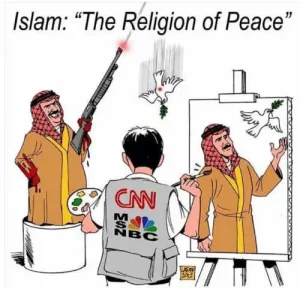
Think about what Zohran Mamdani is doing in New York. Mamdani thinks his job description as New York’s mayor includes being an Interpol cop whose mission is to put Israel’s Prime Minister Netanyahu in shackles and send him to Ryker’s Island.
For critics and security analysts who study political Islam, political engagement is not a series of isolated election cycles but a multi-generational institutional movement. Concerns stem from the belief that activist networks and advocacy groups—such as CAIR, MPAC, or local political action committees—actively recruit, train, and fund candidates to build incremental leverage over time.
Under this view, small numbers today represent the entry point of a deliberate long-term effort (some would say “plot”) to alter American legal standards, public school curricula, and municipal governance from within.
For many citizens, public officeholders serve as symbolic stewards of foundational American values—such as constitutional secularism, individual rights, free speech, and Judeo-Christian heritage.
When Muslim candidates or elected officials express views that appear to challenge traditional constitutional protections, question core foreign policy alliances, or promote religious exemptions for public spaces (such as public calls to prayer or modified local noise codes), it seems to me to be a fundamental challenge to Western civic norms, regardless of the officeholder’s overall percentage in total election statistics.
When you have a nation replete with citizens who are more afraid of being called “Islamophobic” than they are of calling out radical Islamists who are pushing Sharia Law and anti-Judeo-Christian values, it is only a matter of time before we have lost our country.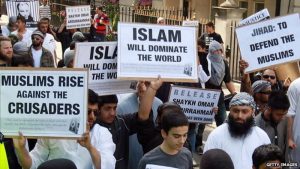
It’s already happening in Europe, where a total of 49 million Muslims, both legal and illegal, have taken up residence in 27 member states with a non-Muslim population of 425 million. Muslims compose about 6 percent of the continent’s population, according to the Pew Research Center. Over the past five decades, the total number of Muslims living in Europe quadrupled from roughly 10–12 million to 49 million.
The average hard-working European had no idea this was happening. To make things even worse, European Muslim populations have a significantly lower median age (around 30–34 years old) compared to the non-Muslim European average (around 43–44 years old). This demographic gap results in higher birth rates among Muslims relative to deaths than among non-Muslim Europeans.
In other words, political success by Islamists is incremental—sometimes almost imperceptible. And that’s the way Muslims want to keep it, until at some point they have gained enough political influence to control the main levers of power.
At that point, it will be too late. Sharia law will have taken hold; fathers will be marrying off their 10-year-old daughters, women will be wearing head-to-toe burqas, we will all be called to prayer five times a day, and a pulled-pork sandwich will be a distant memory.
Maybe a short history lesson would be relevant right now. Muslims learned a hard lesson about Islamic expansion into Europe in 1683 during the Battle of Vienna.

Grand Vizier Kara Mustafa of the Ottoman Empire led an army of roughly 150,000 to besiege Vienna, the heart of the Habsburg Monarchy and the Holy Roman Empire. His goal? To impose Islam on Europe after wiping out every Christian and Jew his army could find.
He was well on his way to achieving his ambition. After two months of intense bombardment with sappers mining under the city’s walls, Vienna was on the brink of collapse.
But just as Vienna was about to fall, King Jan III Sobieski (John III Sobieski) of Poland led a combined relief army of Polish and German forces to the gates of Vienna.
On the afternoon of September 12, Sobieski sent a huge relief force down the slopes of Kahlenberg Mountain. The charge included his elite Polish Winged Hussars, which remain one of the largest recorded cavalry charges in military history.
The assault smashed the Ottoman lines, forcing Kara Mustafa’s forces into a sudden, disorganized retreat. The victory triggered the Great Turkish War (1683–1699), after which the Ottoman Empire lost significant European territories, including Hungary, marking the end of its plans to displace Christianity with Islam in Europe.
Muslims have learned a valuable lesson from that disastrous military confrontation. It’s much easier, though it may take longer, to send regiments of unarmed Muslims into Europe and America to “peacefully” conquer the infidels than it is to do so by military force.
You simply use the infidels’ own liberal rules against them, as well as freedom of speech, a free press, and overly progressive immigration laws that foolishly embrace and welcome the conquerors into the nation.
In 1938, American light verse poet Ogden Nash wrote an allegorical critique of the Empire of Japan’s military expansion and colonization across Asia in the early 20th century. The poem could well have been written today, but with the reference to the Japanese modified to today’s silent Muslim invasion of Europe and America.
Here’s the original poem:
How courteous is the Japanese;
He always says, “Excuse it, please.”
He climbs into his neighbor’s garden,
And smiles, and says, “I beg your pardon”;
He bows and grins a friendly grin,
And calls his hungry family in;
He grins, and bows a friendly bow;
“So sorry, this is my garden now.”
Here’s the slightly updated version:
How peaceful seems the Muslim overseas;
He always says, “Excuse it, please.”
He climbs into his neighbor’s garden,
And smiles, and says, “I beg your pardon”;
He bows and grins a friendly grin,
And calls his hungry family in;
He grins, and bows a friendly bow;
“So sorry, this is my garden now.”
My apologies to Ogden Nash.
–30–
If you enjoyed this post, please consider subscribing to ForeignCorrespondent and tell your friends to subscribe. “It’s free—what a deal!” If you’ve received this from a friend and would like to be added to our distribution list for future blog posts, simply enter your email in the notifications box to sign up:
https://ronaldyatesbooks.com/category/foreign-correspondent.
You can also find my commentaries on Substack at https://ronyates.substack.com/ and the American Free News Network at https://afnn.us.
Please feel free to comment: We genuinely love hearing from you!