
America’s First Amendment makes a simple deal with citizens: the government won’t tell you how to pray, and your religion won’t impose laws governing you or your neighbor. For two and a half centuries, that bargain has kept the peace in a remarkably diverse country.
Now ask yourself an uncomfortable question: What happens when a religion isn’t just a personal faith, but a complete legal code rooted in 7th-century religious jurisprudence that clashes head-on with the U.S. Constitution?
Muslim critics often bristle at any comparison between the Bible and the Koran, arguing that all religions share the same moral DNA. They will argue that in everyday life, millions of American Muslims live peacefully alongside their Christian and Jewish neighbors, raising families, running businesses, and enriching their communities.
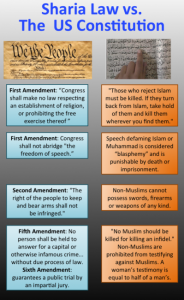
However, when you contrast classical Islamic jurisprudence—Sharia—with the U.S. Constitution, a sharp legal divide emerges. Our Constitution gets its authority from “We the People.” Every citizen stands equal before the law, regardless of creed or gender.
Classical Sharia operates on an entirely different premise: divine law governs both the mosque and the state, and your legal rights depend on your religion and your sex.
Start with the First Amendment. In America, free speech protects your right to criticize, satirize, or leave any religion. Under classical Sharia law, blasphemy and apostasy (leaving Islam) aren’t just sins—they are serious crimes, historically punishable by prison or death in nations ruled by Islamic law.
You cannot square the First Amendment’s open marketplace of ideas with a medieval legal code that criminalizes and punishes religious dissent.
The gap widens under the Fourteenth Amendment’s promise of equal protection. In classical Islamic law, non-Muslims living under Islamic rule historically held dhimmi status—tolerated, yet legally second-class, required to pay a special tax (jizya) as laid out in Quran 9:29. Inside the Muslim family, traditional rules give men unilateral divorce powers while cutting women’s legal standing in testimony and inheritance.
This isn’t an abstract philosophical debate. It has landed squarely in American courtrooms when litigants ask U.S. judges to enforce Sharia law’s religious decrees.

Take the 2008 Maryland case Aleem v. Aleem. A husband tried to use a Pakistani talaq divorce—a Sharia procedure allowing a man to unilaterally end a marriage simply by saying “I divorce you” three times, with no notice to his wife and no court hearing—to strip her of marital property rights. Maryland’s highest court unanimously refused to recognize it, ruling that such one-sided decrees violate basic American guarantees of gender equality and due process.
Just this past September, the Texas Supreme Court reached the exact same conclusion in Azhar v. Choudhri, blocking a husband’s attempt to use a secret Pakistani talaq proceeding to bypass his wife’s constitutional rights in Texas.
Even more troubling was the 2010 New Jersey case S.D. v. M.J.R. There, an imprudent trial judge denied a restraining order to a woman whose husband had repeatedly sexually assaulted her, reasoning that the husband lacked “criminal intent” because he believed his religious law allowed non-consensual marital relations. An appellate court swiftly overturned that ruling, reminding the lower court of a bedrock American rule: your religious beliefs never give you a license to commit a crime.
Whenever you point out these collisions, you’ll hear the same knee-jerk comeback: Well, what about the Bible?
Muslim critics love to remind you that the Old Testament contains harsh ancient penalties—stoning for Sabbath-breakers or adulterers in Leviticus and Deuteronomy) and commands for warfare (such as the conquest of Canaan in Joshua), and that Christian theologians once used verses like Ephesians 6:5 to defend chattel slavery and human bondage.

They’re right—and they’re proving the exact point. When Americans in the South tried to use the Bible to justify slavery, the nation fought a civil war and passed the Thirteenth Amendment to bury it.
More broadly, Western constitutionalism—shaped by both Enlightenment thinkers and the Christian command to render unto Caesar what is Caesar’s and unto God what is God’s—explicitly separated spiritual authority from civil government. Modern Christianity does not demand that Levitical or other ancient biblical criminal codes replace the U.S. Penal Code.
Nobody is campaigning to replace the U.S. Penal Code with Leviticus. Political Islamists, by contrast, explicitly reject the wall between mosque and state, insisting that Sharia must stand above man-made laws.
None of this means Muslims don’t belong in America, or that peaceful Islamic worship threatens the republic. Muslims make up roughly 1 percent of the U.S. population, and amending the Constitution takes a two-thirds vote in Congress plus ratification by thirty-eight states.
The real danger isn’t an overnight constitutional rewrite because a handful of Muslims have been elected to public office in states and communities. It is slow, incremental legal erosion and accommodation—the temptation for courts, school boards, or local officials to carve out “cultural exceptions” that compromise equal rights in the name of DEI sensitivity.

The genius of the 250-year-old American experiment is that it protects the believer without enthroning the belief. A peaceful Muslim praying five times a day and fasting during Ramadan is exercising a right guaranteed by the Bill of Rights. That freedom is sacred and non-negotiable.
However, the moment any movement demands that civil law bow to religious supremacy—whether through speech codes, lopsided divorce decrees, or parallel Sharia courts—the Constitution has to draw a hard and fast line.
Freedom of religion is absolute in America. Freedom to replace the Constitution with Sharia or any other religious law is not.
–30—
If you enjoyed this post, please consider subscribing to ForeignCorrespondent and tell your friends to subscribe. “It’s free—what a deal!” If you’ve received this from a friend and would like to be added to our distribution list for future blog posts, simply enter your email in the notifications box to sign up:
https://ronaldyatesbooks.com/category/foreign-correspondent.
You can also find my commentaries on Substack at https://ronyates.substack.com/ and the American Free News Network at https://afnn.us.
Please feel free to comment: We genuinely love hearing from you!