Dear Reader,
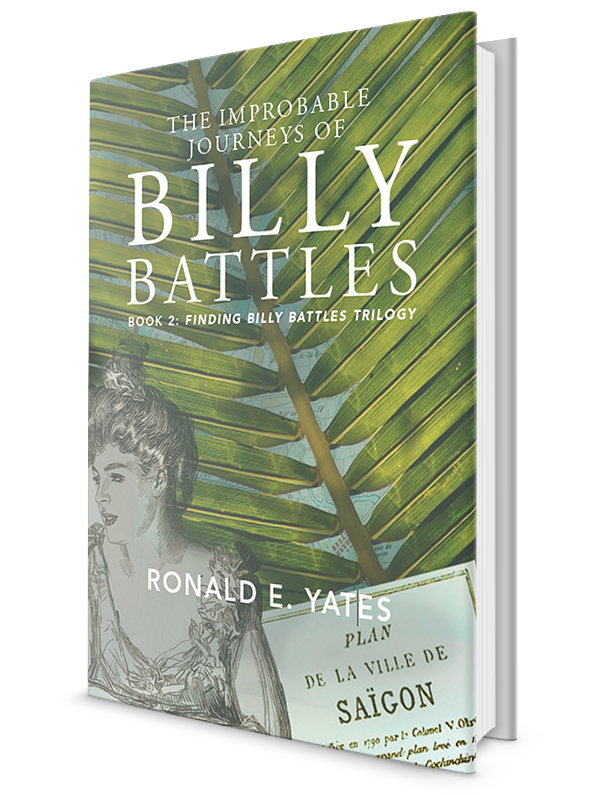
Welcome back to our Saturday serialization of The Improbable Journeys of Billy Battles (Book #2 in the Finding Billy Battles Trilogy).
Book #2 takes Billy’s story to a larger global stage. It leaves the violence of late 19th-century Kansas behind as Billy is thrust into the sweeping historical currents of turn-of-the-century Asia—an inscrutable and sometimes dangerous world that was largely unknown to most Americans of the era.
Last week, we left Billy having learned more than he wanted to about the Baroness von Schreiber and her ill-fated marriage to the Baron Heinrich von Schreiber. This week, Katharina and Billy endure an alarming confrontation in Honolulu.

How the Serialization Works:
- When: Every Saturday morning, a new chapter will land directly in your inbox.
- The Cost: Completely free for all subscribers and followers.
- The Hook: You’ll get a front-row seat to the perilous, accidental adventures that defined Billy’s middle years.
If you are enjoying Billy’s global adventures and want to skip the weekly wait to read the rest of the trilogy, the complete three-book set is available right now on my Amazon Author Page.
Otherwise, settle in, pour a fresh cup of coffee, and let’s rejoin Billy aboard the SS China…
Chapter 4
I awoke the next morning to the sound of someone knocking on my door. For a moment, I thought it was Katharina, back again to provide more details of her troubled past. My past was troubled enough, and I wasn’t sure if I was ready to take on another person’s burdens. I had told her so before leaving her cabin the night before. Katharina apologized for bothering me with her tale of woe and looked at me with the most doleful eyes I had ever seen. Naturally, I agreed to assist her in any way I could.
“Who is it?” I yelled from my bed. I checked my pocket watch on my nightstand. It was barely six thirty.
“Soz ter disturb yew, sir, but we’ll be dockin’ in Honolulu in less van an ’aaahr.” It was Potts. “Can I do anythin’ fer yew befawer we dock?”
I opened the door. There was Potts in his white jacket and black trousers holding a mug of coffee.
“I thought yew might do wiv a cup ter get da day started right,” he said. He had a peculiar smile on his face as though he knew something that he wasn’t supposed to know.
“Thank you, Mr. Potts . . . that’s very kind,” I said, taking the steaming cup of coffee from his hand.
“Well, yew know, after last night an’ all . . .” Potts winked, turned on his heel, and began to walk briskly down the deck.
I suddenly felt embarrassed… not so much for me, but for Katharina, whose reputation among the ship’s staff might now be a bit tainted.
“Potts!” I yelled. He turned, a shocked look on his face.
“Sir?”
I lowered my voice. “Could you come back here for a minute?”
Potts walked back to my cabin door. “What can I do fer yew, guvnor?” he asked.
I looked both ways down the promenade deck, making sure no one was around.
“Potts, I don’t know what you think you might have seen last night.”
“Oh, I didn’t see nothin’, sir . . . It was Ginger, me mate. He seen yew comin’ aaaht ov da lady’s cabin.”
I motioned for Potts to step inside my cabin, and then I shut the door.
“I want to tell you something, and I want you to pass it on to your, uh, friend. What he saw was not what he thinks. I was in the baroness Von Schreiber’s cabin to listen to an account of a series of unfortunate incidents that have been troubling her. Please tell that to your friend and anybody else who may have the wrong idea.”
“Whatever yew says, guvnor,” Potts said. “I didn’t mean anythin’ by it.”
“I’m sure you didn’t, but people can get the wrong idea, and then a very fine lady’s reputation can be severely damaged.”
Potts nodded, opened the door, and turned to leave. “As yew say, guvnor.”
Before Potts could leave, I grabbed his arm and put one dollar in his jacket pocket. “I am counting on you, Mr. Potts!”
“Don’t fink anymawer abaaaht it. I’ll take care ov everything,” Potts said as he walked out and onto the deck.
About an hour later, the ship was anchored in Honolulu Harbor, and I was eagerly preparing to disembark. We were to remain in Honolulu for two days while the ship took on more coal from a coaling barge. Then we were to proceed to Yokohama, Japan.
As I walked to the gangway, I noticed Agnes and Stanley Gladwell standing nearby on the deck along with several other people.
ForeignCorrespondent is a reader-supported publication. To receive new posts and support my work, consider becoming a free or paid subscriber.
“Why, Mr. Battles, where have you been?” Mrs. Gladwell gushed as I approached. “We haven’t seen you here since that first evening. Have you been ill?”
I preferred not to answer, but with the others apparently waiting to hear my answer, I was compelled to explain my absence. I decided to tell a fib in the hopes of ending all discussion of my situation.
“A little seasick,” I lied. “So I’ve been keeping to my cabin.”
“Ah yes, the ‘mal de Mer,’” Mrs. Gladwell said. “Are you aware, Mr. Battles, that seasickness may be wholly prevented by the use of cathartics?”
“Cathartics?”
“Why, yes, the medicine of Brandreth or Wright will serve the purpose . . . or the use of Seidlitz powders or similarly effervescent substances. You must combine those remedies with an abundance of air and exercise, of course.”
“Uh huh . . . well, I have done the latter. I think I have worn a path on the deck. I am eager to get on solid land for a change”
“When we return from going ashore, I will have the steward bring you some of my remedies for the nautical disturbance,” Mrs. Gladwell said. “Stanley and I are leaving the ship later today.”
“I thought you were going to Japan?”
At that point, Stanley Gladwell entered the conversation. “Oh, we are . . . we are merely making a short stopover to tour Oahu. I understand the place is a paradise.”
That comment brought the other six or seven people standing nearby into the conversation, a few of whom actually lived in Hawaii.
As I listened to the chatter about residing in Honolulu, I kept looking up and down the promenade deck for Katharina. We had agreed to meet at the gangway at eight thirty and leave the ship together. I checked my pocket watch. It was about eight forty-five. I wondered what was keeping her, and I thought for a minute about returning to her cabin but decided not to after what Potts had told me.
While I waited, I watched the second- and third-class passengers walk down the gangway on the deck below. As they left the ship, each received a small card.
“Please show this when you return to the vessel,” a steward instructed each passenger. “And please do not lose it. It is your pass back onto the ship.”
“Are you disembarking, Mr. Battles?” Mrs. Gladwell asked, looking at me quizzically.
“Yes . . . uh, in a few minutes. I am just waiting for someone.”
Mrs. Gladwell looked suddenly past my right shoulder, and I could see her eyes widen.
“I see,” she said a bit disdainfully. “We’ll be going then. Come, Stanley, let’s not tarry.” She then turned her back and walked to the gangway. I turned to see what had gotten her rapt attention.
It was Katharina. She was walking toward me and looking resplendent in what was then known as a Gibson Girl outfit: a navy-blue skirt with an embroidered white blouse and a floppy red bow. She wore a navy blue felt hat with a high-squared crown, wide brim, and a white lace hatband tied off in a bow. In her hand, she carried a matching parasol.
As was usually the case, whenever Katharina was in the vicinity, I noticed that all eyes were on her—all, except the Gladwells. They had already taken their reboarding cards and were moving briskly down the gangway.
“I’m sorry to keep you waiting, Mr. Battles,” she said, extending her hand. I just nodded and tipped my hat. She put her arm through mine, and we moved together toward the gangway. As we did, the small crowd that had gathered there parted like a miniature Red Sea. The men’s mouths were brazenly agape, and the women were scrutinizing Katharina as though she were a piece of precious jewelry.
I have to admit, I felt rather exceptional as we took our reboarding cards and walked down the gangway. It’s not every man, I thought, who can accompany the most beautiful woman within thousands of miles on a walk through paradise.
When we reached the dock, I found myself losing my balance. My sea legs were not used to solid ground. Katharina laughed and stumbled.
“Maybe we had better get a carriage before we both fall flat on our faces,” she said.
I hailed one of the open-air tourist hackneys parked along the quay, and we spent the next two hours or so riding through Honolulu. Our driver, a jovial Hawaiian man named Mataio, provided us with a running commentary on the city’s history as we drove.
First, he took us along the waterfront past Wilder’s Steamship Company dock. Then he drove us past the Chinese fish market on Kekaulike Street and past the vast J. T. Waterhouse Import store. Next, he took us down Merchant Street and Hotel Street, past the Hawaiian Hotel on Richards Street, and past Fashion Stables at Hotel and Union Streets.
Honolulu in 1894 didn’t look anything like the place it does today. It was still raw and undeveloped, with a population of about thirty thousand. The entire republic of eight islands only had a population of about one hundred thousand. There were no hotels along Waikiki Beach, which was still a large marshy area of undeveloped lagoons, taro farms, fishponds, coconut trees, and sparkling white beaches.
Mule-drawn tramways carried people along dirt roadways. There was a pristine beauty to the place, and as we rode along in our horse-drawn cab, I wondered what progress might do to the natural beauty of the city and its surroundings. I think we now know.
We finally stopped in front of the Iolani Palace. The imposing palace was once the official residence of Hawaiian queen and ruler Liliuokalani until her overthrow by the so-called Committee of Safety a year before my arrival. Now the building was the Executive Building for the new Republic of Hawaii.
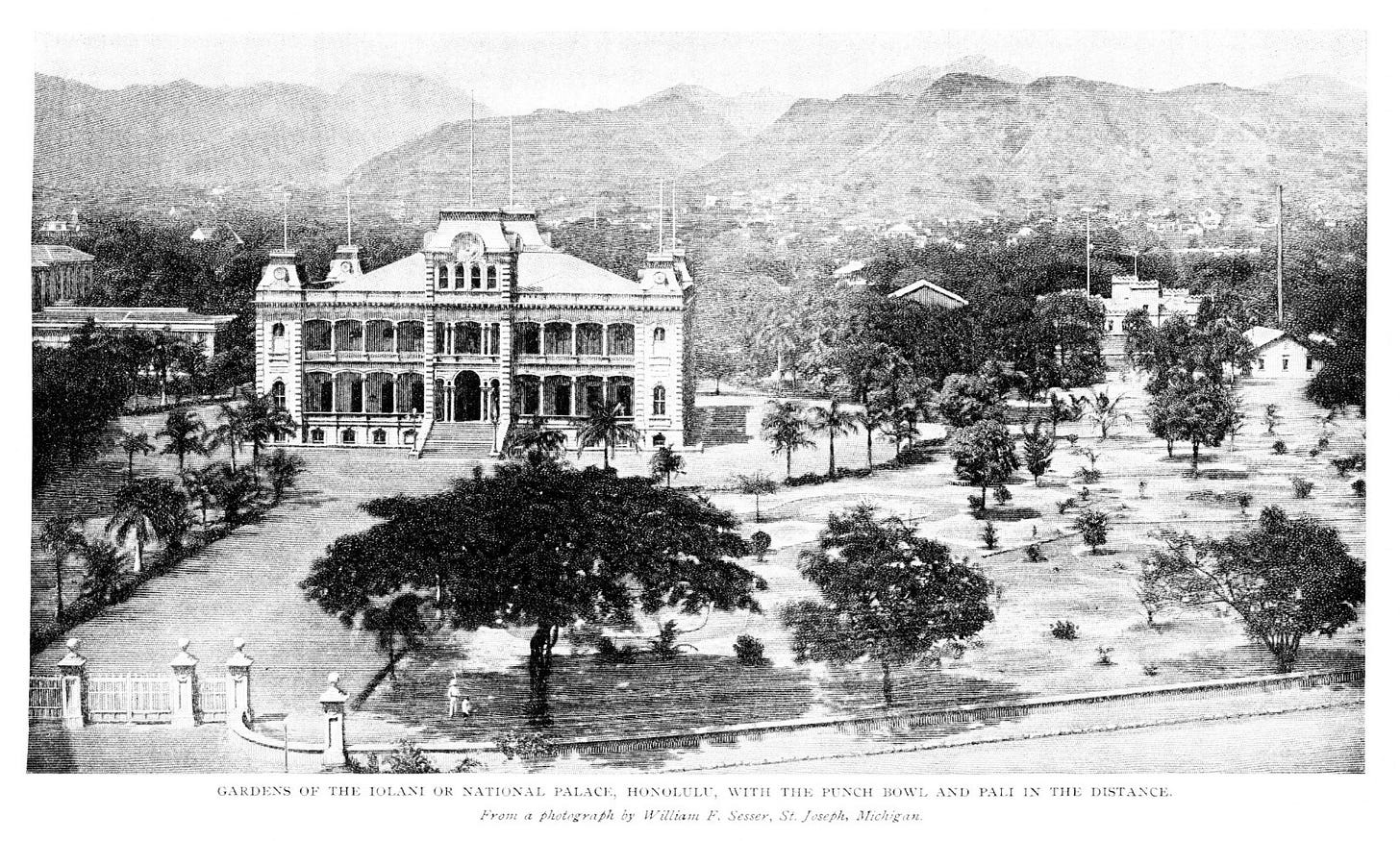
Iolani Palace ca. 1895
“The Americans have taken our kingdom away from us,” Mataio said, sadly looking at the palace. “Now we are American subjects, and our queen is in prison.”
Katharina looked at me. “Sounds familiar, doesn’t it? We so-called civilized people always know what’s best for the natives.”
Mataio tickled the rump of his horse with a long thin whip, and our cab lurched forward.
“And now we go to Diamond Head volcano,” he said. “And after that, to the Punch Bowl crater where you will have a beautiful view of Honolulu.” Katharina and I settled back in our seats.
“This sure beats walking the decks of the SS China,” I said, looking at the long sloping outline of Diamond Head in the distance.
For some fifteen minutes, our carriage bumped along dirt-covered Waikiki Road toward Diamond Head. Mataio provided a running commentary on the scenery and the area we were passing through.
“Waikiki is a Hawaiian word that means ‘spouting water,’” he said, turning around in his seat. “Before the English and Americans came, Waikiki was a green marshland where three mountain streams flowed into the Pacific Ocean. It was a valuable fishing area. Now I am afraid it will be gone before I die.”
Katharina and I looked at each other in silence. She looked off to her right and shook her head.
“How horrible . . . I feel so guilty about all of this because I was married to a man who wanted to do the same all over Asia.”
I looked at Katharina. She turned her head away from me. “I don’t feel guilty, and neither should you . . . You aren’t responsible for what is happening here just because you are an American any more than I am.”
She was about to answer when, without warning, Mataio turned off Waikiki Road onto a much smaller one that headed inland. As soon as he turned, he slapped the horse into a run; and after about fifty feet, he turned right into a narrow drive that led toward a small bungalow. As we approached the cottage, he slowed the carriage to a quick trot, then turned right again and quickly stopped behind a broad wall of bright red bougainvillea.
“What the hell is going on?” I demanded. Katharina and I bounced wildly about in the carriage, and her parasol fell to the floor as she struggled to keep her balance.
“I am sorry . . . Please forgive me . . . but I think someone is following us.”
“What?” Katharina gasped. I jumped from the carriage.
“Are you sure?” I asked, standing next to the carriage.
“Yes, I have watched the carriage follow us from a distance for the past hour or so. It is not one of the regular tourist carriages. And I noticed when we stopped that the carriage stopped also.”
“Why didn’t you say something?” Katharina was standing up in the carriage now.
“Wait just a minute, Katharina. Let me take a look.”
Mataio and I ran to the edge of the bougainvillea and peered around the end so we could see Waikiki Road. Sure enough, a carriage sprinted past the small road we had turned in on and continued. We ran to Waikiki Road and watched the other carriage disappear toward Diamond Head. In the passenger seat, I could see the back of a man’s head. He wore a brown bowler.
We walked quickly back to our coach. Katharina had already climbed down by herself and was standing, hands on hips.
“What did I tell you?” she whispered. “Someone is following me.”
“Or me! Do you forget that Pinkerton detective I told you about?”
Mataio had stood by, watching this exchange without saying anything. Then he spoke up.
“Are you in some kind of trouble?” he asked.
“Not with the law, if that’s what you mean. But there are some people who may want to do the baroness Schreiber some harm.”
“Baroness?” Mataio was apparently impressed by the revelation that he had been carrying aristocracy in his carriage.
“Please! Stop!” Katharina hissed at me. Then, turning to Mataio, she said, “I used to be a baroness, but I, uh, resigned the title.”
Mataio was not having any of it, however. “Please, Baroness, we should go before that carriage returns.”
Katharina gave me an annoyed look. “Now see what you have done?”
I took her hand and helped her up into the carriage. “Sorry. I thought it might take the edge off . . . I think Mataio here thinks we are bank robbers or something.”
“Not at all. You have no money sacks,” he said, laughing.
We returned the same way we had come along Waikiki Road. Mataio kept the carriage moving at a trot. We passed several of the mule-drawn tramcars that plied Waikiki Road between downtown Honolulu and the less settled and open Waikiki area, all the while watching for the carriage that had been following us. Unfortunately, none of us got a look at the person or persons in the carriage, so there is no way we could identify anybody.
I thought back to the Pinkerton man. It couldn’t have been him. He was still standing ashore when the SS China was nudged away from her berth in San Francisco.
“Maybe I was mistaken!” Mataio yelled over his shoulder. “Maybe they were just in a hurry to get somewhere!”
Katharina and I looked at each other. We didn’t have to say anything, but we both had a strong feeling Mataio was wrong. I spent the next several minutes looking over my shoulder to see if there was a carriage coming up behind us. We had gone about a half mile when Mataio pulled the Hackney over to the side of the road next to a long white picket fence.
“This is Queen Liliuokalani’s home,” he informed us. We could make out a large white structure hidden behind a thick stand of palm and coconut trees and other tropical foliage.
“Of course, she used to live in the Iolani Palace,” he continued bitterly. “I think someday she will be restored to her rightful place.”
“Let us hope so,” Katharina said. “Unfortunately, there are always people who want to take away what others have and impose their will on them. Isn’t that right, Mr. Battles?”
“I reckon you’re right . . . but I am not of that flock.”
In 1895, a year after our stopover in Honolulu, there was an attempt by some 150 royalists to overthrow the Republic of Hawaii and restore the queen to her throne. The plot was thwarted when someone tipped off the sheriff.
The royalists fled to Diamond Head and, for several days, fought a pitched battle with the government posse. It was useless, however, and many gave themselves up, while a few fled further inland to Manoa Valley, where they were captured. A few served sentences in Oahu Prison. There was never another attempt to restore the queen to Iolani Palace.
Mataio stood up and peered into the tropical forest surrounding the queen’s house. “Sometimes you can see our queen walking in her garden, but not today, I’m afraid.”
He returned to his seat and flicked the rump of his horse with the reins. The buggy lurched forward, and we continued on to the city.
“If you like, I can take you to Honolulu’s best and oldest restaurant,” Mataio offered. We agreed, and about twenty minutes later, he stopped in front of the Wo Fat Restaurant on the Corner of Hotel and Maunakea streets. It was a green-and-white corner building running about a half-block along both streets, with pagoda-like green-tiled cupolas and white plaster walls.
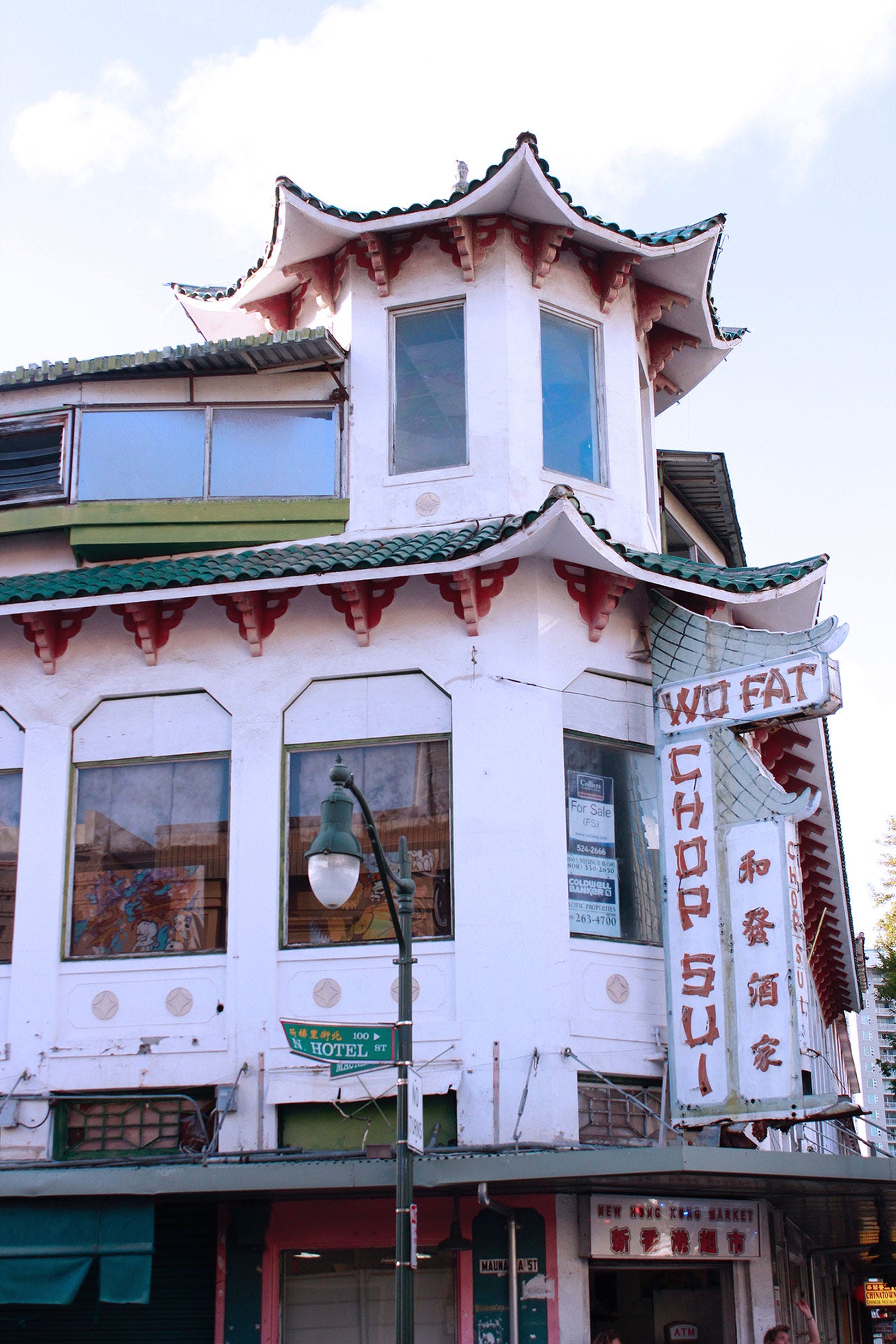
Wo Fat Chop Sui House Restaurant
“Oh, a Chinese restaurant,” Katharina said in an uncharacteristically chirrupy voice. “I haven’t had Chinese food in ages.”
“I don’t think I ever have, though I did know a Chinese cook once.” I paused. “No, that’s not true. He was from Saigon in Cochinchina, not China.”
Mataio stepped down and put a small stepping stool on the muddy street. Then he helped Katharina climb down from the carriage. I jumped out the other side and splashed down into a little mud puddle.
“Won’t you join us, Mataio?” Katharina offered.
“I am sorry, Baroness, but I must take care of the horse. He must eat too, you know. Shall I return in about an hour or so?”
I reached into my pocket and handed Mataio a dollar. “That will be okay.” Then, moving closer to Mataio, I added barely above a whisper, “And if you see that other carriage, please let me know.”
We weren’t the only ones from the SS China dining at the Wo Fat Restaurant that day. A few of our shipmates were there also, as was Deputy Captain Partington, who greeted us as our waiter showed us to a table for two along a back wall. We had arrived a little before one o’clock, and many of the tables were already taken.
“Well, I see you have found the best restaurant in town,” said Partington, whose large round table was about ten feet from ours. He was sitting with eight or nine passengers. We hadn’t been seated more than two minutes when I looked up from my menu to see Partington standing at my side, his hand on my shoulder.
“I say, old boy, might I have a word?” He then looked at Katharina and bowed his head slightly. “Sorry, Baroness, but I shall have him back in a jiff.”
“That’s quite all right, gentlemen. I will need time to figure out this menu. Shall I order for us?”
I nodded. “Yes, thanks. I wouldn’t know where to begin.”
Partington and I made our way out of the restaurant and walked around the corner of Hotel Street.
“Do you know if the baroness was expecting a visitor?” Partington asked.
“I don’t think so.”
“Well, this German chap showed up about a half hour after you and the baroness left, looking for her,” he continued. “He said he represented the German government and produced some official-looking papers to prove it that I couldn’t make out. When I asked what it was about, he said that was between him and Baroness Schreiber. He requested to speak to Captain Kreitz. I took him to the bridge where he demanded to be allowed to search the baroness’s cabin. I didn’t get much of the conversation because it was all in German, but in the end, Kreitz told him he would not be allowed to enter her cabin.”
Now it was beginning to make sense. That man was apparently following us. I didn’t tell Partington that, however. No need muddying the waters.
“Is there something . . . uh . . . I should know?” Partington asked. “Is the baroness in some kind of trouble? You know, she came to me and asked about you. At the dinner that night, I told her you were a U.S. marshal—”
At that point, I interrupted him. “I am not a U.S. marshal. I was a deputy U.S. marshal, and that was a temporary assignment.”
“But the badge you showed Captain Kreitz and me . . .”
“Yes, I still have the badge, but I am not on the payroll of the U.S. government.”
Partington looked down at the ground. “I see . . . but you have agreed to assist her, I take it?”
I nodded. “I guess so.” I didn’t want to go into details about Katharina’s unfortunate past.
Partington looked up from the ground and met my gaze. “You never answered me . . . Is the baroness in some kind of trouble with the German government?”
“Not that I know of. But I think you and the captain did the right thing by not letting that man into the baroness’s cabin.” I turned and began walking toward the restaurant door when I saw the carriage that had followed us coming down Merchant Street. It was about three hundred yards away, and I recognized it by its wheels. The rims were red with white spokes.
I increased my pace. I was in a hurry to get inside before whoever it was in the carriage saw me.
“Well, anyway, thank you old chap,” Partington said, running to catch up to me just as I entered the restaurant. Partington returned to his table, but I remained by the window to see what the man in the carriage might do. He got out and inspected the other carriages and cabs parked around the restaurant.
It was a good thing, I thought, that Mataio had declined Katharina’s invitation for lunch and had driven off to feed his horse. I watched the man make the rounds of carriages. Then he started for the restaurant. I looked over at our table; Katharina was drinking tea out of a handleless Chinese teacup.
I walked briskly over to our table and took Katharina by the arm.
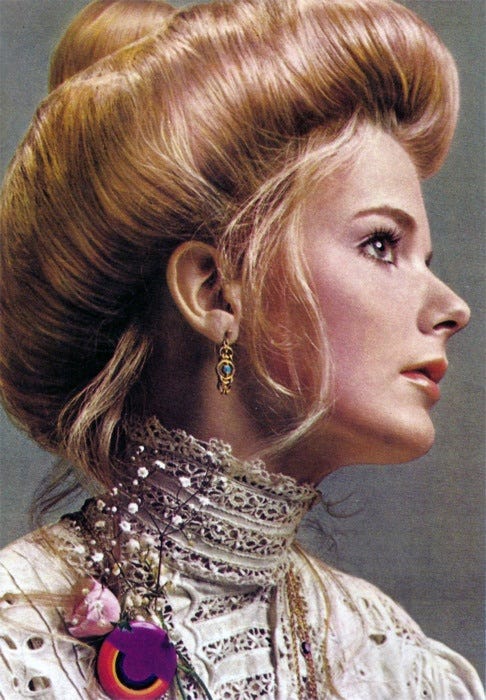
The Baroness Katharina von Schreiber
“We need to move right now!” I whispered. “We are about to have company.” I looked around and saw a blue door at the rear of the restaurant. We hurried through it and found ourselves in a long, narrow hallway leading to what looked like an office.
“Where are we going?” Katharina hissed as I hustled her along and through the door.
“Look,” I said, “the man from the carriage that was apparently following us is outside. Partington told me he came aboard the China looking for you and asked to see your cabin.”
“What! Oh my god!” Katharina’s voice reverberated throughout the hallway.
“Shhhhh . . . I don’t think he knows we’re in the restaurant. Let’s stay here and see what’s what.”
I cracked the door open just enough to see the man enter the restaurant. He wore a stylish brown business suit with a matching derby hat. He looked to be in his midforties and was well over 6 feet tall. He probably weighed 230 pounds. He was, as my cousin Charley Higgins used to say, “Big enough to hunt bears with a switch.”
“What’s going on?” Katharina whispered.
“Shhhh . . . He’s walking over to Partington’s table.”
Dammit, I thought to myself, I hope Partington doesn’t tell them Katharina is in the restaurant.
As the man approached, Partington stood up. I heard the man say something in a roupy voice, though I couldn’t make out what it was. Then I heard Partington. He was angry.
“I say . . . I told you on the ship I have no idea where the baroness is, and nothing has changed.”
Relief washed over me. The man took one last look around the room, then turned and walked back onto the street. Katharina and I waited a few more minutes before returning to our table. Within a minute, Partington was standing beside us.
“What is going on?” he half whispered. “That man is not only unpleasant but also persistent.”
Before I could answer, Katharina said cheerfully, “I already ordered for us, William . . . Heavens, I am famished!”
Partington looked at me quizzically and shrugged. “How much longer can you avoid that chap? Perhaps you should have it out and be done with it.”
“Are you talking to me, Captain Partington?” Katharina asked. “Because if you are, I am right here . . . not over there.” She nodded in my direction.
“I am sorry. I meant no disrespect.”
“None taken . . . but let me explain something to you. I took a peek at that man, and I can tell you with absolute certainty that I have never seen him before in my life. I have no idea what he wants. However, I can say that in Germany, my late husband had many enemies. It is quite possible the people who were my husband’s adversaries are now mine.”
Partington issued a slight bow and then said, “Rest assured, Baroness, that man will not bother you as long as you are aboard the China.”
“I am very much obliged to you, Captain Partington. Now if you will excuse us, Mr. Battles and I have managed to engender terrific appetites after a morning of relentless touring.”
As if on cue, a waiter arrived with a broad array of steaming cuisine I had never seen before.
Partington moved back from the table. “Don’t mention it, Baroness . . . Please enjoy your repast.” With that, he turned to walk back to his table. I stopped him short.
“Could we . . . uh . . . accompany you back to the ship . . . or perhaps follow you in our Hackney?”
“Absolutely . . . I have some business to take care of with the harbor master… I will return in about forty-five minutes. Is that acceptable?”
I nodded, and Katharina and I spent the next half hour or so consuming the diverse menu of dishes she ordered for us. There was chicken pineapple stir-fry, chow gai laan (jade green broccoli), hot and sour pork soup, hoisin pork, and braised hairtail fish in oyster sauce.
“Put some of this on your food,” she said, handing me a small bottle of soy sauce. “It brings out the flavor.”
It was my first real experience with Chinese food, though I had eaten chop suey once at a small Chinese restaurant near the Denver Sun office.
“Well?” Katharina asked as we put our napkins on the table. “Did I order to your liking?”
“Yes, well, everything but that broccoli dish. It was a little limp for my taste.”
“I didn’t want to say anything, but you drowned it in soy sauce. No wonder it was limp.”
“I don’t like broccoli.”
I excused myself and walked to the front door. Mataio was sitting in the carriage across the street. The carriage with red rims and white spokes was nowhere to be seen. I returned to the table, paid our bill, and the two of us walked briskly out of the Wo Fat restaurant and climbed into Mataio’s carriage.
“We’re going back to the ship,” I said.
“But what about the Punch Bowl? And there are many other places I can take you,” Mataio said.
“Change of plans,” I said. “We will see what happens tomorrow. We have another day in Honolulu.”
He started to flick the horse’s rump with his long buggy whip, but I stopped him.
“Not yet! We’re waiting for someone else.” About five minutes later, Partington arrived in another Hackney, and both carriages were quickly on their way to the SS China in the harbor.
************************
NEXT WEEK: Katharina reveals a dangerous secret about Imperial Germany and why she is the target of the German authorities
The Improbable Journeys of Billy Battles (Book 2) All Rights Reserved. © 2016 by R. E. Yates. No part of this book may be used, reproduced, or transmitted in any manner or by any electronic or mechanical means, including information storage and retrieval systems, without prior written permission from the author, who holds the sole right to all characters and concepts herein.
This is an original work of fiction. However, some names, characters, places, and incidents described in this book are based on fact. Others were invented by the author, and any resemblance to persons living or dead, actual events, locales, or organizations is entirely coincidental.
.