
Banned Books Week ended last week, and commentary across media and academia predictably focused on contemporary culture wars, school library challenge lists, and debates over modern content.
Yet, amid the noise of this routine exercise, a far more pervasive and intellectually dishonest form of censorship is being overlooked: the ongoing sanitization of historical fiction and classic literature.
When reading or writing historical fiction, one quickly encounters an undeniable truth: the past owes no one an obligation to conform to 21st-century sensibilities. History is messy, brutal, and frequently offensive to modern eyes and ears.
But today, a strange cultural paradox has taken hold. While modern gatekeepers readily embrace hyper-contemporary, explicit themes (graphic sex, profanity, racism, homosexuality, gender dysphoria) for young audiences under the banner of “expression,” they simultaneously recoil from the authentic language, racial prejudices, and social realities of earlier eras.
As literature is increasingly expected to mirror present-day orthodoxy, authentic historical fiction is becoming a primary casualty of ideological conformity. Retrofitting modern terminology into an 1860s setting—or stripping period vernacular from 19th-century classics—isn’t polite or protective. It is anachronistic deceit.
Sanitizing the past doesn’t educate readers; it misinforms them, robbing history of its raw truth and literature of its moral weight. Yet that is exactly what is happening today, even as we lament the need for a Banned Books Week.
The list of historical and classic novels censored or banned in America keeps growing, with nary a peep from the self-appointed guardians of literature—The American Library Association (ALA) and PEN America.
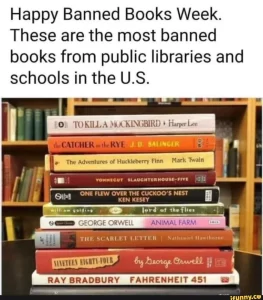
Look at the list that follows—books I read in high school or college that represent some of the best literature ever produced. Yet schools either ban these books outright or scrupulously sanitize them to scrub away offensive language from past eras. Altering historical dialogue or concepts to fit 21st-century norms erases history. Presenting history through a modern lens distorts how people thought, spoke, and acted, robbing readers of the ability to understand cause and effect across generations.
When a school district removes Huckleberry Finn or To Kill a Mockingbird from a 9th-grade required reading list, advocacy organizations often label it a curriculum change rather than an absolute library ban. That’s how these organizations ban historical and classic literature without calling it a ban.
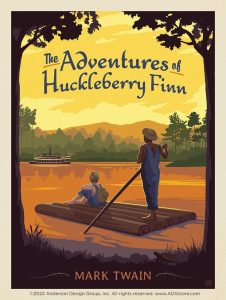
Classics Frequently Removed or Challenged Today
| Title & Author | Primary Arguments / Reasons Cited | Common Context of Removal | ||
| The Adventures of Huckleberry Finn
by Mark Twain |
Use of racial slurs (e.g., the N-word over 200 times), period-accurate depictions of 19th-century race relations, claims of causing psychological harm to minority students. | Districts across California, Minnesota, Virginia, and Pennsylvania removed it from required reading lists and classroom instruction. | ||
| To Kill a Mockingbird
by Harper Lee |
Frequent use of racial slurs, reliance on a “white savior” narrative, and a focus on a rape accusation are claims that it centers white perspectives on Black trauma. | Pulled from required reading lists in school districts like Burbank (CA), Duluth (MN), and Mukilteo (WA). | ||
| Of Mice and Men
by John Steinbeck |
Use of racial slurs, profanity, dark themes (euthanasia), and offensive depictions of people with intellectual disabilities. | Removed from middle and high school curricula in several districts nationwide. | ||
|
Little House on the Prairie (Series) by Laura Ingalls Wilder |
Dehumanizing depictions of Native Americans (e.g., phrases like “the only good Indian is a dead Indian”), period-typical settler colonialism perspectives. |
Phased out of elementary reading lists; led to the Association for Library Service to Children stripping Wilder’s name from its annual book award in 2018. |
||
| The Catcher in the Rye
by J.D. Salinger |
Excessive vulgarity/profanity, themes of teenage rebellion, blasphemy, and sexual references. | Perennial subject of challenges; frequently removed from required reading lists in high schools. | ||
| Lord of the Flies
by William Golding |
Profanity, explicit violence, themes of innate human savagery, and derogatory language regarding physical disabilities. | Removed from various middle and high school English programs over violence and language concerns. | ||
| The Great Gatsby
by F. Scott Fitzgerald |
Sexual references, language, illegal activity (bootlegging), and themes of cynicism/immorality. | Challenged in public schools and private academic institutions. | ||
Historical fiction authors like me, who faithfully represent an era’s language, biases, and vernacular, provide primary-level insight into that period’s social reality. Expunging historical language risks sanitizing history and obscuring the real cultural conditions under which historical figures lived and wrote.
Critics arguing against these texts in K–12 classrooms often assert that requiring young students to read slurs aloud or ingest period-typical prejudice creates an uncomfortable environment, particularly for minority students.
I disagree unreservedly. Using period-accurate language—even when offensive by today’s standards—provides an authentic primary-source representation rather than an endorsement of the period’s values.
When the characters in my books use accurate period language, including epithets and racial and ethnic slurs, I give readers an honest, faithful representation of the setting and times in which my books are set.
A healthy culture trusts readers, including young adults, to process difficult, uncomfortable history without needing a curated or sanitized narrative. Shielding readers from historical prejudice doesn’t erase the past; it weakens their ability to critically analyze how societies evolve.
A serious, disingenuous contradiction exists between institutions that promote complex, explicit adult themes in modern literature and those that simultaneously attempt to sanitize or censor historical texts like Little House on the Prairie or Huckleberry Finn. This reveals a double standard: cultural institutions protect readers from uncomfortable historical truths while exposing them to modern, often controversial and provocative ideological content.

For example, these contemporary books appeared on the 2026 list of books banned by some schools and libraries:
- Sold by Patricia McCormick (a powerful novel about human trafficking)
- Speak by Laurie Halse Anderson (a young adult classic dealing with trauma and isolation)
- Crank by Ellen Hopkins (exploring adolescent addiction)
- The Handmaid’s Tale by Margaret Atwood (the modern dystopian classic)
- The Kite Runner by Khaled Hosseini (exploring guilt, redemption, and friendship against the backdrop of changing Afghan history)
Selective outrage across the political spectrum creates a notable paradox: challenges against books from the right often focus on modern themes of gender and sexuality, while challenges from the left often target classic texts for outdated historical language and racial depictions.
As a historical fiction author, I think my primary duty is to be truthful to the setting and characters. Using period-inaccurate terminology (like applying modern terms to 19th-century figures) isn’t merely a stylistic choice; it misleads readers about the time period’s social structures.
Having a white slave owner in a book set in 1850s Mississippi call a slave an “African American” rather than using the “N-word” is preposterous. The fact is, the term gained initial momentum during the Black Power and Civil Rights movements of the late 1960s, transitioning away from terms like “Negro” or “colored.” However, it didn’t truly solidify in mainstream media and everyday speech until late 1988 and early 1989.
As one of my fellow historical fiction authors once told me, “Any author who uses the term African American in a book set in the 19th century should be horsewhipped.”
There is a difference between discomfort and harm when writing about the past. Discomfort is a necessary byproduct of studying real history. Sanitizing language removes the conflict and oppression historical figures actually faced, ultimately undermining the struggles and resilience of those who lived through those eras.
Authentic historical fiction demands a steadfast commitment to accuracy; sanitizing the language and social realities of the past to satisfy modern sensibilities is both anachronistic and misleading.
The impulse to rewrite or scrub historical literature to suit modern sensibilities has generated significant debate and outrage.
For example, Mark Twain’s masterpiece, The Adventures of Huckleberry Finn, has long been targeted for its heavy use of a historical racial slur. Most famously, NewSouth Books published an edition that replaced the slur with the word “slave.” While intended to make the book more palatable for middle-school classrooms, literary critics heavily debated and criticized the move, arguing that sanitizing Twain’s text defangs his sharp social critique and masks the true ugliness of historical racism.

Another target of retrospective editing has been Laura Ingalls Wilder’s Little House on the Prairie books. Publishers and estates have altered specific archaic phrasing—most notably updating a line in Little House on the Prairie that stated “there were no people” in the territory because it was inhabited by Native Americans, changing it to reflect historical presence, along with other adjustments to language concerning Indigenous characters.
Today, a double standard exists between how modern challenge campaigns and educational frameworks treat contemporary social/sexual themes and how they treat historical artifacts and terminology. Retrofitting modern morality onto history distorts truth and misinforms readers.
We need to resist today’s “Nanny Culture” when it comes to the books and even films that young people are exposed to. We need to uphold intellectual rigor over censorship when it comes to our history, and that requires facing its dark, uncomfortable aspects directly.
History is not a curated museum exhibit designed to pacify our modern sensibilities; it is a complex inheritance. If we deny younger generations the unvarnished reality of our past—warts, slurs, and all—we do not protect them. We simply leave them unequipped to understand how we arrived at the present.
Sanitizing the past doesn’t erase unpleasant history; it erases our ability to learn from it. True intellectual courage means confronting the uncomfortable truths of earlier eras without feeling compelled to rewrite them. If we lose the stomach for history as it happened, we forfeit the right to claim we understand it at all.
–30—
If you enjoyed this post, please consider subscribing to ForeignCorrespondent and tell your friends to subscribe. “It’s free—what a deal!” If you’ve received this from a friend and would like to be added to our distribution list for future blog posts, simply enter your email in the notifications box to sign up:
https://ronaldyatesbooks.com/category/foreign-correspondent.
You can also find my commentaries on Substack at https://ronyates.substack.com/ and the American Free News Network at https://afnn.us.
Please feel free to comment: We genuinely love hearing from you!