
What follows is drawn from a story I filed to the Chicago Tribune a few days after the Tiananmen Square massacre in Beijing. Last Thursday, on June 4, I posted my recollections of that terrible day on my Substack homepage. If you have not read that piece, I hope you will pause here and read it first; it casts necessary light on all that follows. You can find that post in the archives section of my Substack homepage.
On the morning of June 10, 1989—six days after the Chinese Army slaughtered thousands of students and protesters in Tiananmen Square—Beijing’s city buses began to run again. It was about eight o’clock, and I climbed aboard one of the red-and-white buses.
I chose Bus No. 1 of the Beijing Municipal Transportation Authority, which traveled for several miles along Jianguomenwai Avenue, with Tiananmen Square on one side and the Forbidden City on the other. I also hoped to speak with Chinese passengers about what had unfolded in the square and across Beijing less than a week earlier.
The whole passage felt dreamlike, as though the bus and all of us aboard had slipped into another realm. As we moved on, the silence was so deep it seemed almost audible. Faces were pressed to the windows, taking in the wreckage the massacre had left behind—crumpled bicycles, and long rows of burned tanks, trucks, and armored personnel carriers gathered in parks and parking lots that had become graveyards of metal.
The story I filed on June 10, 1989, follows:
My Tour of Post-Massacre Beijing: This Bus Brakes for Bullets
As soon as you climb aboard Bus No.1 of the Beijing Municipal Transportation Authority, you know you’re in for an unusual ride.
“If there is shooting, please don’t panic because we are entering the military zone,” says a female conductor as the bus pulls away from the stop in front of the Friendship Department Store. There is a ripple of facetious sniggering from the 60 or so people crammed into the red and white bus.
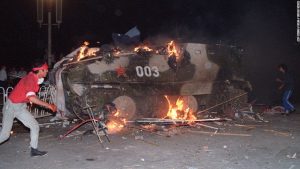
It is the first day the buses in Beijing have operated since the carnage last Sunday morning in Tiananmen Square and since the streets of Beijing were littered with the burned-out carcasses of buses, trucks, and armored personnel carriers.
For much of the week, roughly 350 buses, including Bus No. 1, had served as makeshift roadblocks, used by Beijing residents to keep troops from entering the city. Most are now bound for the scrap heap. Bus No.1 was lucky, I guess.
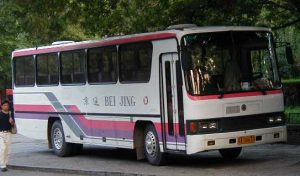
As bus No. 1 picks up speed, it crosses the overpass that carries Jianguomenwai Avenue over South Chao Yang Men Avenue, where, for a good part of the week, about 20 T-59 tanks had blocked the roadway. They are gone now, somewhere on the outskirts of the capital.
But stony-faced troops stand every ten yards along the railings on both sides of the overpass, their AK-47 rifles and submachine guns at the ready. They stare blankly at our bus as it rumbles by.
There is a wave of discreetly muted disapproval from many passengers, just as there is when the bus passes several patrols of soldiers with red armbands.
These are the troops that Beijing’s martial law command announced had been given authority to “dispose of on the spot” anybody they decided was resisting arrest.
Bus No. 1 continues down Jianguomenwai past Chongwenmennei Street, where the wide boulevard suddenly becomes East Chang’an Street of Heavenly Peace.
To the right looms the Beijing Hotel, one of the vantage points from which some of the foreign press watched the bloody clashes in Tiananmen. Closed under martial law, it stands empty as thousands of bicyclists stream past.
Two streets farther on, the route is blocked. From that point, only military vehicles, tanks, and Bus No. 1 are allowed into the world’s largest public square. The same is true two blocks west of Tiananmen.
As the bus enters the square, passengers crane for a view through the dirty windows. The chatter stops. Riders look out in silence on the vast common where thousands of pro-democracy students and their supporters were slaughtered. For many, it is their first look at Tiananmen since Sunday’s bloodbath, and there is a collective gasp.
On the north side of the square, just under a huge picture depicting the benign countenance of Chairman Mao Tse-tung and in front of the vermilion walls of the Forbidden City, 38 T-59 tanks stand side by side.
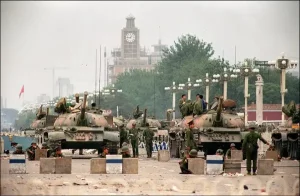
Their guns point, somewhat disrespectfully, toward Mao’s massive tomb at the south end of the square.
About 250 armored personnel carriers, trucks, generators, trailers, and radio vans stand between them. Several hundred soldiers are clearing piles of debris that litter the square.
“Just wait,” says one man. “It gets much better down the road.”
Sure enough, as the bus rumbles past patrol after patrol of army troops, past street cleanup crews, past the Minzu Hotel and the Five Star Brewery, it suddenly stops to pick up more passengers in front of a sea of burned-out military vehicles.
The bus erupts into an excited rattle of exclamations as passengers try to count the disabled vehicles. There are easily 60 or 70 burned and blackened vehicles lined up bumper to bumper.
“The people did that?” asked one incredulous rider. “It doesn’t seem possible.”
Two blocks down, in another plaza just before the Yanjino Hotel, are some 40 charred buses. In front of them, vendors sell garlic, cabbage, and leeks.
“Such a waste,” said the conductor, nodding her head toward the buses.
The bus slows, caught in a traffic jam of military trucks packed with soldiers who stare blankly at the terrified faces of the bus passengers.
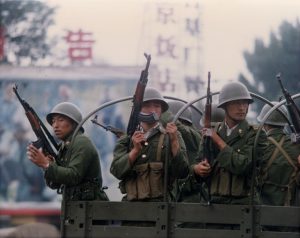
Many riders shrink into their seats, recoiling from guns just four feet away. Some soldiers grin at their discomfort; others wave and smile, as if trying to put them at ease.
“Where are you from?” one passenger yells at a 20-something soldier.
“Not from here,” answers the soldier with hard black eyes.
The bus lurches ahead, leaving the trucks loaded with armed soldiers behind. There is a shared sigh of relief.
About 20 minutes into the trip, I noticed several Chinese passengers looking at me—the only Wàiguó rén (foreigner) on the bus. Finally, two middle-aged women sitting in front of me turned in their seats.
“Excuse me, but may I ask you a question?” one of the women asked.
“Shì de,” I replied—Yes.” Then, continuing, I said in halting Mandarin: “I am sorry. I am American, and my Mandarin is poor.” I had only managed to learn a few Mandarin phrases during my three weeks in Beijing.
“That is okay,” one of the women said in English. “I am a high school English teacher.”
I nodded. “Okay, then.”
The woman asked why I was in Beijing, and I explained that I was a foreign correspondent for the Chicago Tribune and had arrived a few weeks earlier to cover the students’ takeover of Tiananmen Square.
“You witnessed what happened?” she asked.
“Yes.”
“Did you write about it?”
“Yes, I did.”
“The world must think the Chinese people are barbarians.”
“I don’t think the world blames the Chinese people, only the leaders of the Chinese Communist Party. They are the ones who ordered the massacre.”
The woman nodded and looked around the bus. Other passengers were straining to hear our conversation, and at that point, she must have decided that silence might be a better option. As I learned during my time in Beijing, the CCP has spies and informers everywhere.
“Thank you,” the woman whispered. “Thank you for telling the world.” Then, she and her friend turned around in their seats.
I continued the rest of the ride silently. I had the feeling that others wanted to talk to me, but they didn’t dare to.
When the bus reached the end of the line, it turned around and returned to the Friendship Department Store, where I had gotten on about an hour before.
As I was exiting the bus, a man who looked to be in his 70s tapped me on the shoulder and said:
“The last time I saw so many armed soldiers in the heart of Beijing was in 1949, after Chiang Kai-shek was driven out. I am sorry to see that the soldiers have returned, but I am happy the buses are running again.”
“Shì de,” I replied, nodding in agreement.
Thank God for little favors, I thought to myself as I walked back to my hotel. The buses are running again, but thousands of people who occupied Tiananmen Square will never ride them again.
–30–
If you enjoyed this post, please consider subscribing to ForeignCorrespondent and tell your friends to subscribe. “It’s free—what a deal!” If you’ve received this from a friend and would like to be added to our distribution list for future blog posts, simply enter your email in the notifications box to sign up:
https://ronaldyatesbooks.com/category/foreign-correspondent.
You can also find my commentaries on Substack at https://ronyates.substack.com/ and the American Free News Network at https://afnn.us.
Please feel free to comment: We genuinely love hearing from you!