
As ballots in California’s “jungle primary” continue to dribble in, it appears that incumbent Los Angeles Mayor Karen Bass and L.A. City Council member Nithya Raman will be battling it out in November for mayor of the City of Angels.
Why Bass and Raman?
Blame California’s ludicrous jungle primary, in which the two top vote-getters, regardless of party affiliation, move on to the November election. In this case, both Bass and Raman are Democrats.
That means it’s time to strip away the spin and judge these candidates by their political instincts and their records in power.
Meanwhile, poor Spencer Pratt, a Republican running for mayor as an independent, can only wonder what might have been had Los Angeles’s oblivious voters opted for the kind of change the city and California both so desperately need after 16 years of a disastrous Democratic Party monopoly.
Pratt saw his second-place spot in the primary election slowly erode as late mail-in ballots for Raman suddenly pushed her into second place.
Just like New Yorkers who inexplicably elected a communist Muslim named Zohran Mamdani as their mayor, and Chicagoans who bizarrely decided in 2023 to elect a communist named Brandon Johnson, the 3.9 million blockheads who live in Los Angeles will get just what they deserve—another four years of ineffective and deceptive leadership, no matter which of the leftist harpies wins in November.
Let’s look at these two leftist harpies. In case you may have forgotten, harpies are mythical creatures in Greek and Roman mythology, depicted as half-woman, half-bird beings. They are known for their fierce and vengeful nature.
So where do they fall on the political spectrum?
Karen Bass is allegedly aligned with the center-left establishment of the Democratic Party. Her ultra-progressive approach focuses on coalition-building with labor, business groups, and moderate factions. While critics point to her early activist-communist history, including her work with the Venceremos Brigade in the 1970s and her esteem for Cuba’s Fidel Castro, her governing style as mayor is mostly allied with moderate and left-wing policies.
Nithya Raman sits noticeably further left on the political spectrum. An urban planner by trade, Raman is backed by the Democratic Socialists of America (DSA) and represents the growing far left wing in L.A. politics. She advocates for aggressive structural overhauls regarding housing, climate mandates, and renter protections, often placing her far to the left of the city’s traditional political center.
What about their political track records?
Bass’s supporters contend that she inherited a city facing a deepening crisis and has stabilized the ship. They highlight her “Inside Safe” initiative, which moved thousands of people off the streets and into dozens of LA motels, resulting in a marginal reduction of large street encampments in downtown LA. Her backers view her ties to state and federal leaders as crucial for securing municipal funding.
Opponents argue that Bass’s administration relies heavily on costly temporary solutions and bureaucratic committees without fixing underlying issues. They cite the Inside Safe policy as a temporary fix rather than a long-term solution. Public frustration spiked following the devastating 2025 Palisades wildfire, the most destructive in the city’s history, and was compounded by recent economic challenges and job losses in the Hollywood film industry. For critics, a vote for Bass represents a vote to continue an ineffective status quo.
As the representative for Council District 4 for the past five years, Raman’s role covers a broad municipal portfolio, though housing and homelessness have been her primary focus. Beyond serving on committees handling housing and homelessness, city council members manage basic district infrastructure, land-use zoning, public safety allocations, and environmental policies.
Bass’s campaign has already come out swinging against Raman, charging that she has allowed homeless encampments near schools.
That charge stems from Raman’s consistent opposition to and votes against Municipal Code Section 41.18, a controversial city ordinance that prohibits homeless individuals from setting up tents or camping within 500 feet of schools, daycare centers, parks, and libraries.
Raman argues that these “no-camping zones” amount to “political theater” that merely shuffles encampments from one block or neighborhood to another without solving the root problem. She advocates for a “housing-first” approach rather than enforcement-led sweeps.
Raman is the first South Asian woman to serve on the city council, and her tenure has been deeply polarizing, depending on who you ask.
Supporters praise her for pioneering a “services-first” outreach model in her district, bypassing traditional encampment sweeps to connect the homeless with temporary shelter and permanent housing. The result? Homeless encampments proliferate downtown Los Angeles, with street crime by drug-infused “zombies” ubiquitous, according to Pratt.
Bass and other critics rate her poorly, pointing to persistent homeless encampments near schools, etc. They argue that her past support for defunding LA’s police department has weakened public safety. They also say her policy-driven approach emphasizes long-term planning at the expense of immediate enforcement of public-space laws.
Raman has aggressively turned the “failure” narrative back on Mayor Bass, seizing on data from Bass’s flagship Inside Safe initiative. Raman has pointed out that roughly 40% of the program’s participants have ended up back on the streets, calling the $300 million motel-focused initiative fiscally unsustainable and poorly managed. Raman instead advocates for expanding short-term rental vouchers (Time Limited Subsidies), which she argues can house three times as many people for the same cost.

Given that the political math in Los Angeles heavily favors the left, it is no wonder that two Democrats will be battling it out in November to keep the miserable status quo in LA rather than pushing for any substantive changes.
Just look at the voter registration breakdown in Los Angeles:
Democrats: 55%–60%
Independents (No Party Preference): 20%–25%
Republicans: 12%–15% (down from 32% in the early 1990s)
Other Minor Parties: 5%
This deep-blue baseline makes it difficult for a traditional Republican or conservative platform to win citywide, often shifting major contests into battles between competing wings of the Democratic party.
And that is exactly what ruling Democrats in Sacramento had in mind when, in 2010, they rammed through a constitutional amendment with just 54 percent approval that created the Jungle Primary. Unlike traditional partisan primaries, where political parties hold separate elections to select their nominees, California consolidates all candidates onto a single unified ballot.
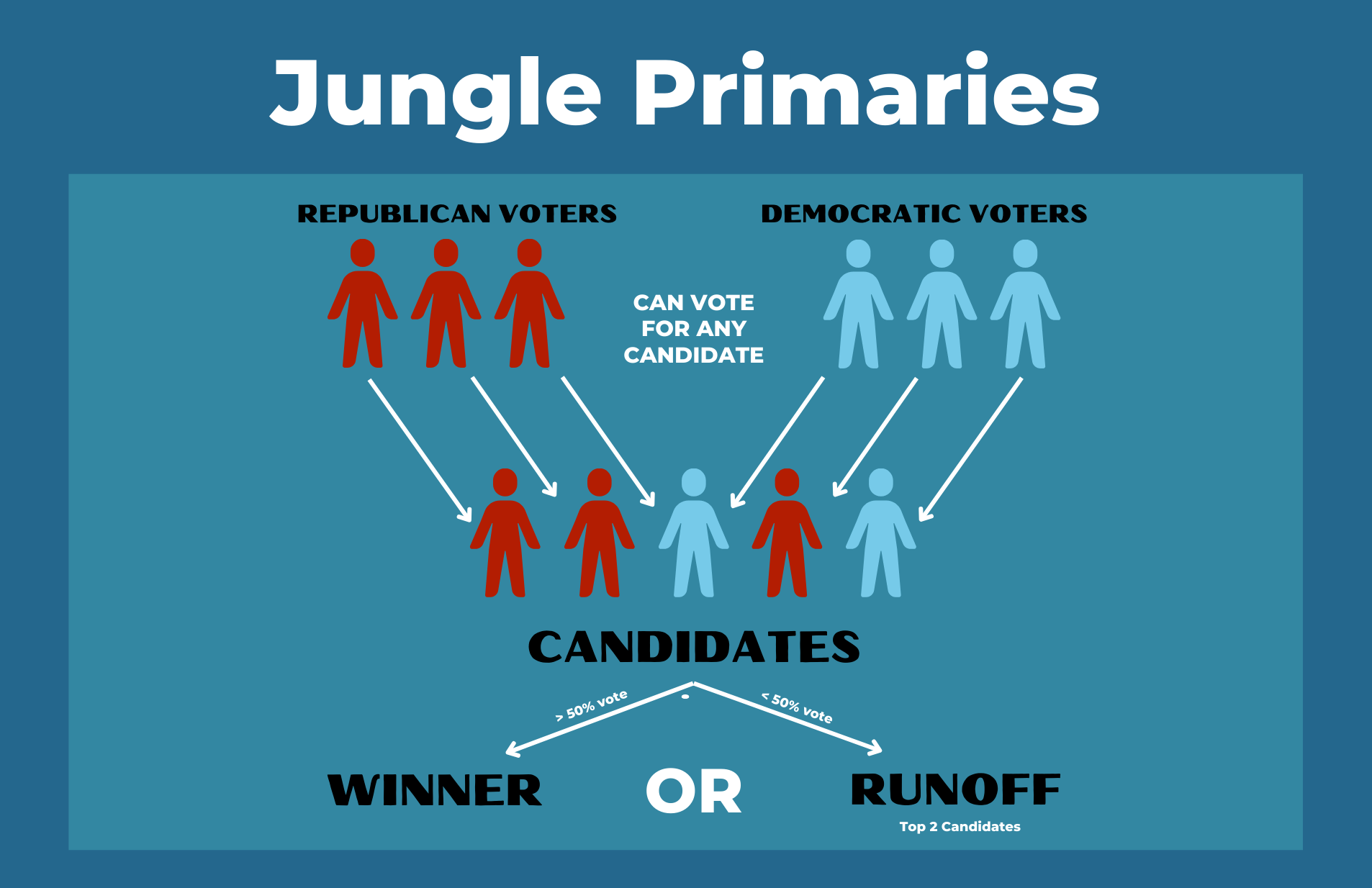
In a primary election, every registered voter receives the exact same ballot, regardless of their own political party affiliation (or lack thereof). On this ballot, all candidates running for a specific office are listed together. Candidates are permitted to list their party preference (e.g., “Democratic,” “Republican,” or “No Party Preference”) next to their name, but allegedly they are not running as official, party-sanctioned nominees.
Given the fact that Los Angeles is about 60 percent Democrats (roughly the same percentage as the entire state of California), is it any wonder that Democrat candidates are usually the top two vote-getters in primaries?
If two candidates from the same political party finish first and second in the primary, they will face each other in November. Therefore, it is common in deep-blue California districts like LA to see two Democrats battling it out in the general election while Republican candidates sit helplessly on the sidelines.
Hence, we have Bass and Raman, so no matter who wins, a Democrat will be administering Los Angeles. That doesn’t bode well for the Trump administration’s policy of mass deportation of illegal and criminal migrants.
California is home to more undocumented immigrants than any other state in the nation, with approximately 2.25 million unauthorized immigrants living in the state, according to the Public Policy Institute of California and Pew Research Center.
Los Angeles County has long served as the primary gateway and cultural hub for illegal migration into California, holding the largest concentration of undocumented residents in the state. Data from the Migration Policy Institute puts the unauthorized population of Los Angeles County at approximately 1.10 million people, meaning nearly half of all illegal migrants in California reside in L.A. County.
The estimated population of illegal migrants within the city limits of Los Angeles is between 400,000 and 450,000. That means the city accounts for roughly 40% of the county’s illegal migrant population.
The most recent targeted enforcement numbers for LA County are roughly 2,000 individual detentions over a 100-day window between January and March 2026, according to the Deportation Data Project.

That’s a relatively small drop in the bucket. But to hear Bass squealing about it, you would have thought that all 450,000 illegals had been deported from LA.
Neither Bass nor Raman supports federal agencies such as Immigration and Customs Enforcement (ICE) or Customs and Border Protection (CBP). As a result, tensions between L.A. City Hall and federal immigration officials continue to reflect a long-running debate over public safety and local authority.
Bass and other progressive city leaders like Raman defend “sanctuary city” policies by arguing that separating local police work from federal civil immigration enforcement builds trust. They maintain that if immigrant communities are afraid local authorities will hand them over to ICE or CBP, they will stop reporting crimes, acting as witnesses, or seeking emergency medical care—ultimately harming public safety citywide.
Opponents of sanctuary city policies argue that restricting cooperation with federal agencies shields individuals who have committed criminal offenses from deportation. They believe this stance prioritizes political ideology over public safety, hampering law enforcement’s ability to remove bad actors and straining local resources.
I agree. Under what circumstances should American citizens be expected to live alongside millions of people who are in the country illegally and are using taxpayer-funded federal and state resources—or, worse, defrauding the nation and costing the public hundreds of billions of dollars?
Apparently, Bass and Raman see nothing amiss here.
So, what are we to make of these twin socialist sisters, who are essentially interchangeable in their political and social beliefs?
For one thing, they are not outliers among blue-city leadership in America. The shift toward communist or democratic socialist mayors in major metropolitan centers like Chicago (Brandon Johnson) and New York City (Zohran Mamdani) reflects broader national trends in American cities.
Rising housing costs & eviction threats, dissatisfaction with traditional centrist politics, and the high concentration of progressive & younger voters are turning blue cities like Los Angeles into moribund and dilapidated socialist sanctuaries rather than the progressive meccas Democratic leaders promise.
As a result, the impact on businesses is a subject of intense economic concern. High commercial tax rates, onerous regulatory hurdles, and unresolved public safety concerns are primary drivers forcing prominent corporations and small retailers to flee urban centers for more business-friendly states like Texas, Florida, and Tennessee.
Critics argue that investing heavily in social safety nets, public infrastructure, and affordable housing is the only way to build a sustainable consumer base and workforce for the future in cities such as Los Angeles. But with billions of dollars ($29 billion statewide) going to L.A.’s 45,000 homeless people within the city limits (75,000 in LA County), the money is not going where it is needed.
Los Angeles is relying heavily on temporary housing programs like “Inside Safe” to clear visible street encampments by moving people into motels and master-leased buildings. Critics and civil rights advocates alike worry about the sustainability of this approach.
For example, there is immense concern that the city will rely on short-term “beautification” sweeps to temporarily hide the crisis from global media during the upcoming FIFA World Cup and the 2028 Summer Olympic Games, rather than solving the systemic deficit of permanent supportive housing and mental health infrastructure.
And let’s not forget about LA’s freeways. They are legendary for their congestion. During the Olympics, adding over a million projected visitors sounds like a recipe for total gridlock.
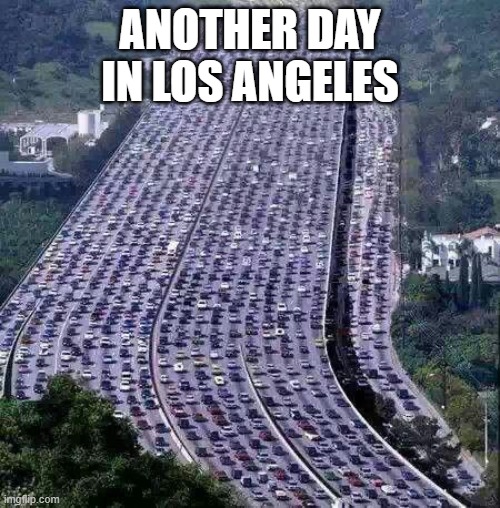
LA28 has officially designated the 2028 Olympics as a “Car-Free Games.” Under the LA Metro 2028 Mobility Concept Plan, spectators will be prohibited from driving or parking at any of the 49 competition venues.
To make this work, LA Metro is planning a “Games Enhanced Transit System” (GETS), borrowing roughly 2,000 supplemental buses from surrounding municipalities to run dedicated, fast-track transit corridors. Security perimeters will entirely restrict private vehicle access near venues, pushing traffic away from core stadium zones.
It sounds good on paper, but making this work in a city and metropolitan area that is solidly automobile and truck-dependent seems like a pipe dream to me.
Luckily for Bass or Raman, there will be a federal buffer for the LA Olympic Games. Because the Olympics have been designated a National Special Security Event (NSSE) by the Department of Homeland Security, the U.S. Secret Service will take the lead on security integration.
And local law enforcement will not act alone. Thousands of federal agents, military personnel, and mutual-aid officers from outside jurisdictions will be deployed to secure the venues, transit hubs, and public spaces, helping offset local police staffing shortages.
Before the social and political shifts of 2020 and the emergence of the “defund the police” movement, the “normal” or baseline staffing level for sworn officers in the Los Angeles Police Department (LAPD) hovered right around 10,000. Today, just 8,800, cover LA’s massive geographic footprint of 503 square miles.
Even at its peak of nearly 10,000 officers, Los Angeles historically operated with one of the lowest officer-to-resident ratios among major American cities—24 officers per 10,000 residents. Compare that with Chicago’s 44 officers per 10,000 residents or New York City’s 42 officers per 10,000 residents.
Sanctuary-city advocates may dislike it, but the reality is unavoidable: the LAPD cannot handle Olympic security on its own. Federal ICE, CBP, and DHS personnel will be deployed across Los Angeles.
I don’t expect sanctuary-city true believers like Bass or Raman to welcome that reality. But whichever of these harpies occupies LA City Hall, as well as the voters who chose them over Spencer Pratt, will have no choice but to accept things as they are, not how they may have wished them.
Los Angeles voters had a chance to choose a different course, and they let it slip away.
That failure will define what comes next.
–30–
If you enjoyed this post, please consider subscribing to ForeignCorrespondent and tell your friends to subscribe. “It’s free—what a deal!” If you’ve received this from a friend and would like to be added to our distribution list for future blog posts, simply enter your email in the notifications box to sign up:
https://ronaldyatesbooks.com/category/foreign-correspondent.
You can also find my commentaries on Substack at https://ronyates.substack.com/ and the American Free News Network at https://afnn.us.
Please feel free to comment: We genuinely love hearing from you!

Cui bono?